


A licensed, locally registered remodeler can deliver a predictable kitchen renovation in St. Petersburg on a clear schedule and within defined cost bands. For a light cosmetic refresh, expect to spend a few thousand dollars and finish within a few weeks. A mid-range renovation with new cabinets, countertops, and updated plumbing typically runs $16,773–$24,736 and takes 6–10 weeks. A full custom remodel with layout changes, premium appliances, and structural work can cost tens of thousands of dollars and take several months to complete. Elite Builder Renovation has completed 375+ projects across the Tampa Bay area and handles permits, inspections, and contractor registration with the City of St. Petersburg from day one.
Before any work begins, verify your contractor holds a current state license, carries adequate insurance, and is registered with the Pinellas County Construction Licensing Board (PCCLB). The City of St. Petersburg issues permits through its online Citizen Access Portal and requires a Certificate of Occupancy (CO) for certain remodel scopes. Your immediate next step: call or submit an online request for a written estimate so you have a documented scope and price before committing to anything.
Table of Contents
- What kitchen remodeling services do St. Petersburg contractors offer?
- What does the remodeling process look like from start to finish?
- How much does a kitchen remodel cost in St. Petersburg?
- What permits does a St. Petersburg kitchen remodel require?
- How do you choose the right St. Petersburg kitchen contractor?
- What does Elite Builder Renovation’s local project work look like?
- Which design trends and materials work best for Tampa Bay kitchens?
- What warranties and post-installation support should you expect?
- Why hire a local St. Petersburg remodeler instead of a national or out-of-area firm?
- What challenges are specific to kitchen remodeling in St. Petersburg?
- Key Takeaways
- Elite Builder Renovation serves St. Petersburg homeowners from estimate to final walkthrough
- Useful sources
- FAQ
What kitchen remodeling services do St. Petersburg contractors offer?
Local contractors serving St. Petersburg, Clearwater, and the broader Tampa Bay area typically cover the full spectrum of kitchen work, from a single-day cabinet refresh to a gut-to-studs rebuild. Matching the right service to your actual goals keeps your quote accurate and your timeline realistic.
Core services available from a full-service remodeler include:
- Cabinet refacing: Replace doors and drawer fronts while keeping the existing box structure. Best when the layout works and the boxes are structurally sound.
- Semi-custom and custom cabinetry: New cabinets built to your kitchen’s exact dimensions. Semi-custom ships in 3–5 weeks; fully custom can run 6–10 weeks.
- Countertop replacement: Swap laminate for quartz, granite, or butcher block without touching cabinets or plumbing. A fast, high-impact upgrade.
- Appliance packages: Coordinate new appliance installation with electrical and plumbing rough-in to avoid code conflicts.
- Plumbing and electrical upgrades: Relocating a sink, adding a gas line, or upgrading to a 240V range circuit all require licensed trade work and permits.
- Layout and structural changes: Opening a wall between the kitchen and living area, moving a load-bearing beam, or relocating the island footprint.
- Flooring, backsplash, and lighting: Finish-level upgrades that dramatically change the look without structural implications.
- Water damage restoration: Mold remediation and structural drying before any finish work begins. Water damage restoration in St. Petersburg is a distinct service that must precede cosmetic work.
Elite Builder Renovation covers all of these services for homeowners in St. Petersburg, Clearwater, Largo, Safety Harbor, and across Pinellas and Hillsborough Counties. For a full-service estimate, visit the kitchen remodeling in St. Petersburg, FL service page.
Pro Tip: Product warranties depend heavily on installation quality. Even premium cabinetry can fail prematurely if the installer doesn’t account for Florida’s humidity and hurricane-zone requirements. Always confirm that your contractor’s workmanship warranty covers both labor and material performance under local climate conditions.
What does the remodeling process look like from start to finish?
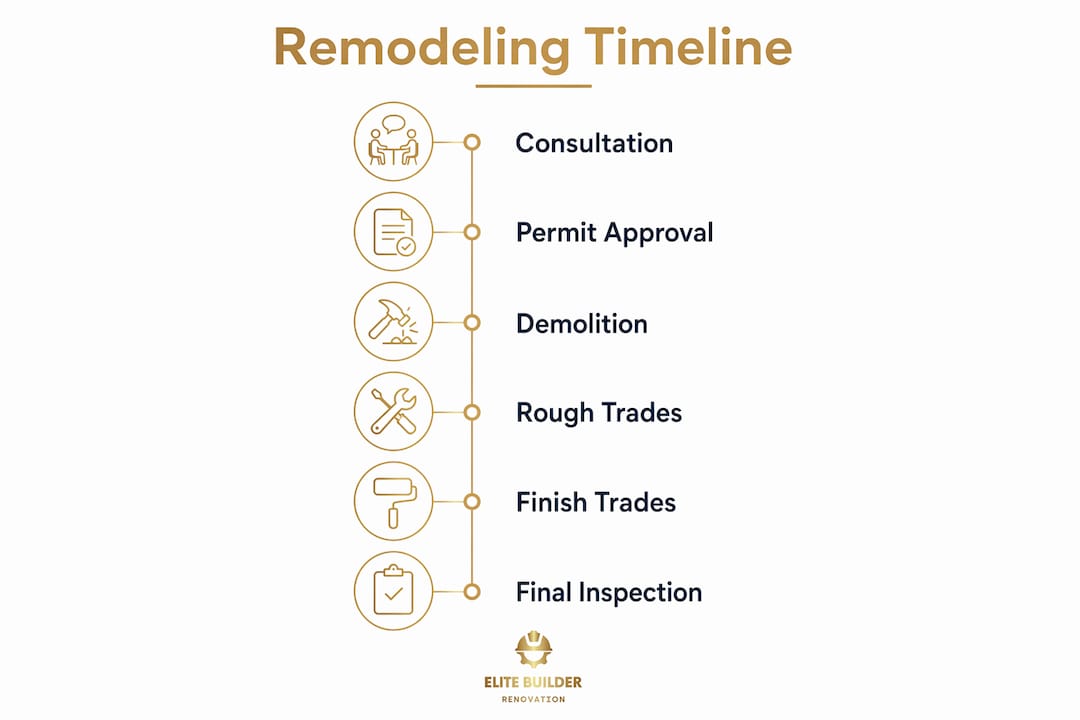
Answer first: a St. Petersburg kitchen remodel moves through six phases, and the permit window is the most variable. Plan for it, and the rest of the schedule holds.

Phase 1: Consultation and design (1–2 weeks)
Your contractor measures the space, reviews your goals and budget, and produces a design proposal. This is also when scope decisions that affect permits get locked in. Changes after this phase cost time and money.
Phase 2: Permit application and approval (2–4 weeks)
Most kitchen remodels in St. Petersburg require at least one permit. Applications go through the city’s Citizen Access Portal. Plan review typically takes 2–4 weeks for standard residential work, though flood-zone and historic-district properties can take longer.
Phase 3: Demolition (3–5 days)
Existing cabinets, countertops, flooring, and any walls slated for removal come out. A licensed contractor will protect adjacent surfaces, cap utilities safely, and dispose of debris per city requirements.
Phase 4: Rough trades (1–2 weeks)
Plumbing, electrical, and HVAC rough-in happens before any walls close. Inspections are scheduled through the Municipal Services Center (MSC) or the online portal. Rough-in inspections must pass before insulation or drywall proceeds.
Phase 5: Finish trades (2–6 weeks)
Cabinets, countertops, flooring, backsplash, fixtures, and appliances are installed in sequence. Cabinet lead times are the most common scheduling bottleneck: semi-custom and custom cabinets typically require 4–8 weeks from order to delivery.
Phase 6: Final inspection and walkthrough (3–5 days)
The city inspector signs off on completed work. Your contractor walks you through every finish item, documents punch-list corrections, and delivers warranty paperwork.
| Phase | Typical Duration |
|---|---|
| Consultation and design | 1–2 weeks |
| Permit application and approval | 2–4 weeks |
| Demolition | 3–5 days |
| Rough trades and inspections | 1–2 weeks |
| Finish trades (cabinets, counters, flooring) | 2–6 weeks |
| Final inspection and walkthrough | 3–5 days |
| Total (mid-range project) | 6–10 weeks |
Pro Tip: Tampa Bay’s busy season runs October through April. Contractors book up fast, and cabinet suppliers often have longer lead times during that stretch. If you want a kitchen ready before the holidays, start your consultation in August at the latest.
How much does a kitchen remodel cost in St. Petersburg?
Most St. Petersburg homeowners spend between $16,773 and $24,736 for a mid-range kitchen renovation, with modeled local pricing placing the per-square-foot baseline around $165. Small cosmetic projects can come in under $10,000; full custom renovations with layout changes regularly exceed $37,000 and can reach $96,000 for large, high-end kitchens.

| Scope | Typical Cost Range | What’s Included |
|---|---|---|
| Light refresh | A low-cost range | |
| Paint, hardware, backsplash, lighting, minor fixture swap | ||
| Mid-range renovation | A moderate cost range | |
| Semi-custom cabinets, quartz counters, appliances, plumbing update | ||
| Full custom remodel | A high-cost range | |
| Custom cabinetry, layout changes, premium appliances, structural work |
For a detailed Florida-specific breakdown, the kitchen renovation cost guide for Florida covers line-item allocations by scope.
What drives the price up most
Layout changes are the single biggest cost multiplier. Moving a sink, relocating a gas line, or opening a load-bearing wall each adds licensed trade labor, permit fees, and inspection time. Custom cabinetry is the largest discretionary line item, often representing a significant portion of the finish budget. Switching cabinet tiers early in the design process has the biggest effect on total cost.
Appliance packages, countertop material selection, and flooring type each contribute meaningfully but are easier to adjust mid-design without affecting structural scope.
Financing options
Elite Builder Renovation offers financing options to make projects financially accessible. Contractor-arranged financing typically covers the full project cost with fixed monthly payments. Homeowners may also explore home equity lines of credit (HELOCs) or personal renovation loans through their bank. Always compare the annual percentage rate (APR) and confirm whether the financing is secured or unsecured before signing.
Pro Tip: Set aside a 10–20% contingency before you start. Behind-wall surprises, plumbing reroutes, and code-compliance upgrades are common in St. Petersburg homes. Also confirm whether your contractor’s warranty covers installation labor separately from the product manufacturer’s warranty — they are not the same coverage.
What permits does a St. Petersburg kitchen remodel require?
Most kitchen remodels in St. Petersburg require at least one permit. The city processes applications through its online Citizen Access Portal, and homeowners or contractors can schedule inspections through the Municipal Services Center at One 4th St. N, open Monday through Friday, 8 a.m. to 4 p.m.
Effective July 1, 2026, Florida House Bill 803 introduced a permit exemption for single-family dwelling work under $7,500, but it explicitly excludes structural, mechanical, electrical, plumbing, and gas work, as well as flood-prone properties. In practice, most kitchen remodels involve at least one of those excluded categories, so the exemption rarely applies to a full renovation.
Properties in designated flood zones or historic districts face stricter review requirements. Work that might qualify for an exemption elsewhere may still trigger a full plan review, engineered drawings, or an elevation certificate in those areas.
Contractor verification checklist
Before signing a contract, confirm all of the following:
- State license: Verify the contractor’s Florida state license number directly with the PCCLB.
- PCCLB registration: Confirm the contractor is registered and in good standing in Pinellas County.
- City contractor affidavit: The contractor must submit a Contractor Affidavit to the City of St. Petersburg, including proof of insurance with the City named as certificate holder.
- Workers’ compensation: Confirm active workers’ comp coverage or a valid exemption on file.
- Insurance certificate: The certificate must name the City of St. Petersburg as certificate holder.
A Certificate of Occupancy is required for certain remodel scopes, including change of use, structural modifications, and rebuilds following fire or flood damage. Your contractor should confirm CO requirements during the permit application phase, not at the end of the project.
How do you choose the right St. Petersburg kitchen contractor?
Start with a non-negotiable baseline: the contractor must hold a current Florida state license, carry adequate insurance, and be registered with the City of St. Petersburg. Everything else is secondary to those three.
Contractor evaluation checklist
- Verify the state license number directly with the PCCLB at pcclb.com.
- Confirm active general liability insurance and workers’ compensation coverage.
- Check that the contractor has submitted a current City of St. Petersburg Contractor Affidavit.
- Request at least three local references from completed St. Petersburg or Pinellas County projects.
- Review a portfolio of before-and-after photos from comparable kitchen scopes.
- Confirm the contractor pulls permits and attends all required inspections.
Interview questions worth asking
- What is your workmanship warranty, and does it cover labor separately from product warranties?
- Do you use subcontractors? If so, are they licensed and insured under your policy?
- How do you handle change orders, and what triggers one?
- Who is the on-site project manager, and how often will you communicate updates?
- What does your payment schedule look like, and is it tied to project milestones?
Red flags to watch for
- A large upfront cash payment (more than 10–15% before materials are ordered).
- No written contract or a contract with vague scope language.
- Inability to provide a local license number or PCCLB registration.
- No local references or a portfolio limited to out-of-area projects.
- Pressure to skip the permit process to “save time.”
Contract clauses to insist on
Your signed contract should include a fixed scope of work with a documented change-order process, a payment schedule tied to defined milestones (not calendar dates), explicit language about who pulls permits and attends inspections, and a written warranty covering both workmanship and materials. Out-of-area contractors who lack local registration are a documented risk: missing city registration can trigger stop-work orders and permit delays that extend your project timeline by weeks.
What does Elite Builder Renovation’s local project work look like?
Elite Builder Renovation has completed 375+ remodeling projects across St. Petersburg, Clearwater, Tampa, and the surrounding Tampa Bay area, with kitchen renovations representing a significant share of that portfolio. The team documents each project with before, mid-build, and finished photography so homeowners can evaluate workmanship at every stage, not just the final reveal.
A well-documented portfolio should show you:
- Before photos: The existing condition, including cabinet layout, countertop surface, and any visible moisture or structural issues.
- Mid-build photos: Rough-in plumbing and electrical, framing changes, and cabinet installation before countertops go in.
- Finished photos: Final lighting, hardware, backsplash, and appliance placement under real conditions.
- Inspection records: Permit cards and passed inspection documentation, confirming code compliance.
You can read verified client feedback on the Elite Builder Renovation reviews page. When evaluating any contractor’s testimonials, look specifically for mentions of permit handling, timeline accuracy, and post-installation follow-up, since those details reveal how the contractor performs when something unexpected comes up.
Which design trends and materials work best for Tampa Bay kitchens?
For 2026, St. Petersburg homeowners are gravitating toward durable, moisture-resistant finishes that hold up in Florida’s humidity and still appeal to Pinellas County buyers. The short answer: prioritize function first, then aesthetics, because the climate will test every material choice you make.
Trending design directions and who they suit:
- Quartz countertops with waterfall edges: Non-porous, low-maintenance, and resistant to the mold growth that granite can harbor in high-humidity environments. Suits modern and transitional kitchens.
- Shaker-style cabinetry in warm whites or soft greens: Timeless enough for resale, current enough for 2026 buyer expectations. Specify humidity-rated finishes and moisture-resistant MDF or solid wood construction.
- Luxury vinyl plank (LVP) flooring: Outperforms engineered hardwood in Florida’s humidity swings and costs significantly less than tile in labor. Practical for coastal cottage and contemporary styles alike.
- Mixed-metal hardware (brushed brass + matte black): A detail-level trend that adds visual depth without a full cabinet replacement. Works across most design profiles.
- Open shelving with closed lower cabinets: Balances the airy, open feel popular in coastal homes with the practical storage most families need. Avoid open shelving near the stove or dishwasher where steam exposure is highest.
- Under-cabinet and toe-kick LED lighting: Adds both function and ambiance; LED strips are low-heat and low-maintenance in humid conditions.
For material selection specific to Florida’s climate, corrosion-resistant hardware and humidity-rated finishes are not optional extras. Salt-air exposure in coastal St. Petersburg neighborhoods accelerates corrosion on standard steel fasteners and hardware within a few years. Specifying marine-grade or stainless hardware adds a modest cost but protects the investment.
Pro Tip: Quartz countertops and LVP flooring consistently rank among the highest-return upgrades for Pinellas County resale. Buyers in this market expect durable, low-maintenance finishes. Choosing materials that signal durability, not just style, tends to recover more of the remodel cost at sale. For a deeper look at statewide trends, see Elite Builder Renovation’s guide to kitchen renovation trends in Florida.
What warranties and post-installation support should you expect?
A kitchen remodel is a long-term investment, and the warranty structure matters as much as the price. There are two distinct warranty layers: the product manufacturer’s warranty (covering cabinets, countertops, and appliances) and the contractor’s workmanship warranty (covering installation labor and any defects in how materials were applied).
These are not the same coverage, and confusing them is one of the most common post-project disputes. A cabinet manufacturer may warrant the box for 10 years, but if the installer used non-humidity-rated fasteners and the cabinet pulls away from the wall in year two, the manufacturer’s warranty will not cover the labor to fix it. Your contractor’s workmanship warranty should.
Ask for both warranty documents in writing before the project starts. Confirm the workmanship warranty term (one year is a minimum; two to five years is better), what it covers, and the process for filing a claim. Elite Builder Renovation provides a 100% satisfaction guarantee and documents warranty terms as part of the project contract, so there is no ambiguity about coverage after the final walkthrough.
Post-installation support also means responsiveness. A contractor who is difficult to reach after the check clears is a red flag that surfaces quickly. Local contractors with an established presence in St. Petersburg and Pinellas County have a reputational stake in follow-through that out-of-area firms simply do not.
Why hire a local St. Petersburg remodeler instead of a national or out-of-area firm?
Local knowledge translates directly into fewer surprises and faster permit approvals. A contractor who regularly works in St. Petersburg knows the city’s Citizen Access Portal, has an existing relationship with the Municipal Services Center, and understands which inspectors handle residential kitchen work. That familiarity shortens the permit window and reduces the risk of a stop-work order from a missed registration step.
Out-of-area contractors frequently lack current City of St. Petersburg contractor registration. That gap can trigger stop-work orders and permit delays that extend your project timeline by weeks, with no recourse except waiting. Local contractors renew their PCCLB registration annually between June 1 and September 30, keeping their credentials current and their city registration active.
There is also a practical accountability difference. A St. Petersburg-based remodeler with 375+ local projects has a reputation to protect in the community where they work. If a warranty issue surfaces six months after completion, a local contractor is reachable and motivated to resolve it. A national franchise or out-of-area crew that has moved on to the next market has far less incentive to return.
Finally, local contractors understand Florida-specific material requirements that generic national specs miss. Humidity-rated cabinet finishes, corrosion-resistant fasteners, and flood-zone compliance are standard considerations for an experienced Tampa Bay remodeler, not afterthoughts.
What challenges are specific to kitchen remodeling in St. Petersburg?
St. Petersburg’s climate and regulatory environment create a distinct set of project considerations that homeowners should plan for before the first estimate arrives.
Humidity and moisture management are the most persistent material challenges. Florida’s year-round humidity accelerates mold growth behind walls, under sinks, and inside cabinet boxes, particularly in older homes. A thorough pre-demo moisture inspection can reveal hidden damage that, if left unaddressed, will compromise new finishes within a year or two. Elite Builder Renovation’s water damage restoration service addresses this before any new materials go in.
Flood zone and historic district requirements add permitting complexity that surprises many homeowners. Properties in FEMA-designated flood zones may require elevation certificates, and substantial improvement rules can trigger a full structural review if the remodel value exceeds a threshold relative to the home’s assessed value. Historic district properties in St. Petersburg face additional design review requirements that can extend the permit timeline.
Older home infrastructure is a factor in some St. Petersburg neighborhoods. Homes built before the 1990s may have galvanized plumbing, aluminum wiring, or undersized electrical panels that must be upgraded to meet current code before a kitchen remodel can proceed. These are not optional upgrades; they are code compliance requirements that a licensed contractor will identify during the design phase.
Hurricane-season scheduling affects both contractor availability and material lead times. The June–November hurricane season coincides with slower contractor schedules in some trades, but post-storm demand can spike sharply and push lead times out. Planning a remodel start date outside peak storm season, or locking in materials before June, reduces scheduling risk.
For permit-specific guidance on Florida remodels, Elite Builder Renovation’s article on permits needed for home remodels in Florida covers the application process in detail.
Key Takeaways
A licensed, locally registered St. Petersburg contractor who handles permits, uses humidity-rated materials, and provides a written workmanship warranty is the most reliable path to a predictable kitchen remodel in Pinellas County.
| Point | Details |
|---|---|
| Realistic cost bands | Light refresh: under $10,000; mid-range: $16,773–$24,736; full custom: $37,000–$96,000+. |
| Verify credentials first | Check state license and PCCLB registration before signing any contract. |
| Budget a contingency | Set aside 10–20% above the quoted price for behind-wall surprises and code upgrades. |
| Permit timelines matter | Plan 2–4 weeks for permit approval; flood-zone and historic-district properties take longer. |
| Elite Builder Renovation | Serves St. Petersburg and Tampa Bay with 375+ completed projects and a 100% satisfaction guarantee. |
Elite Builder Renovation serves St. Petersburg homeowners from estimate to final walkthrough
St. Petersburg homeowners get a remodeler who already knows the city’s permit portal, the PCCLB registration requirements, and the material specs that hold up in Florida’s climate. Elite Builder Renovation has delivered kitchen remodels across Tampa Bay for over a decade, with 375+ completed projects and a 100% satisfaction guarantee on every one. The team manages permits, inspections, and contractor registration so you don’t have to track those moving parts yourself. Financing options are available to fit a range of budgets, and every project starts with a written estimate that documents scope, timeline, and payment milestones before work begins.
To schedule a consultation or request a written estimate for your home remodeling in St. Petersburg, FL, call Elite Builder Renovation directly or submit a request online. If you’re also considering a kitchen remodel in Clearwater or nearby areas, the same team and process apply across Pinellas County.
Useful sources
The following official and authoritative sources cover permits, licensing, and contractor verification for St. Petersburg kitchen remodels. Save these links before you start the permit and hiring process.
- City of St. Petersburg Building Permits: File permit applications, schedule inspections, and access the Citizen Access Portal.
- Pinellas County Construction Licensing Board (PCCLB): Verify contractor licenses, check insurance status, and report unlicensed activity.
- Pinellas County Contractor Licensing Department: Background on PCCLB scope, annual renewal windows (June 1–September 30), and county ordinances.
- City of St. Petersburg Contractor Affidavit: Required documentation and insurance minimums for contractor registration with the City.
- St. Petersburg List of Exempted Permits: Clarifies which work is exempt and where flood-zone or historic-district rules override exemptions.
| Source | What it provides |
|---|---|
| City of St. Petersburg Citizen Access Portal | Online permit applications and inspection scheduling |
| PCCLB (pcclb.com) | Contractor license and insurance verification |
| Pinellas County Contractor Licensing Dept. | County-level licensing rules and renewal deadlines |
| City Contractor Affidavit (PDF) | Required insurance minimums and registration documentation |
| St. Petersburg Exempted Permits List (PDF) | Scope of permit exemptions and flood/historic-district exceptions |
FAQ
Most St. Petersburg homeowners spend between $16,773 and $24,736 for a mid-range kitchen renovation; small cosmetic remodels can cost under $10,000, and full custom renovations often exceed $37,000 for large projects.
A practical starting budget is $16,773–$24,736 for most St. Petersburg kitchens, plus a 10–20% contingency for behind-wall surprises; small cosmetic remodels can cost under $10,000, while full custom renovations often exceed $37,000, especially with layout changes or premium appliances.
Do I need a permit for a kitchen remodel in Florida?
Most kitchen remodels require at least one permit because they involve plumbing, electrical, or structural work. Florida’s 2026 permit exemption for work under $7,500 explicitly excludes those trade categories, so the exemption rarely applies to a full renovation.
What is the new look for kitchens in 2026?
Quartz countertops, shaker-style cabinetry in warm whites or soft greens, luxury vinyl plank flooring, and mixed-metal hardware are the dominant trends in St. Petersburg for 2026, with an emphasis on moisture-resistant materials suited to Florida’s climate.
What is the 30% rule in remodeling?
The 30% rule is a general guideline suggesting you spend no more than 30% of your home’s current market value on a single remodel to protect resale return. It is a planning benchmark, not a legal requirement, and your actual budget should be guided by your home’s value, your goals, and a written estimate from a licensed local contractor like Elite Builder Renovation.