

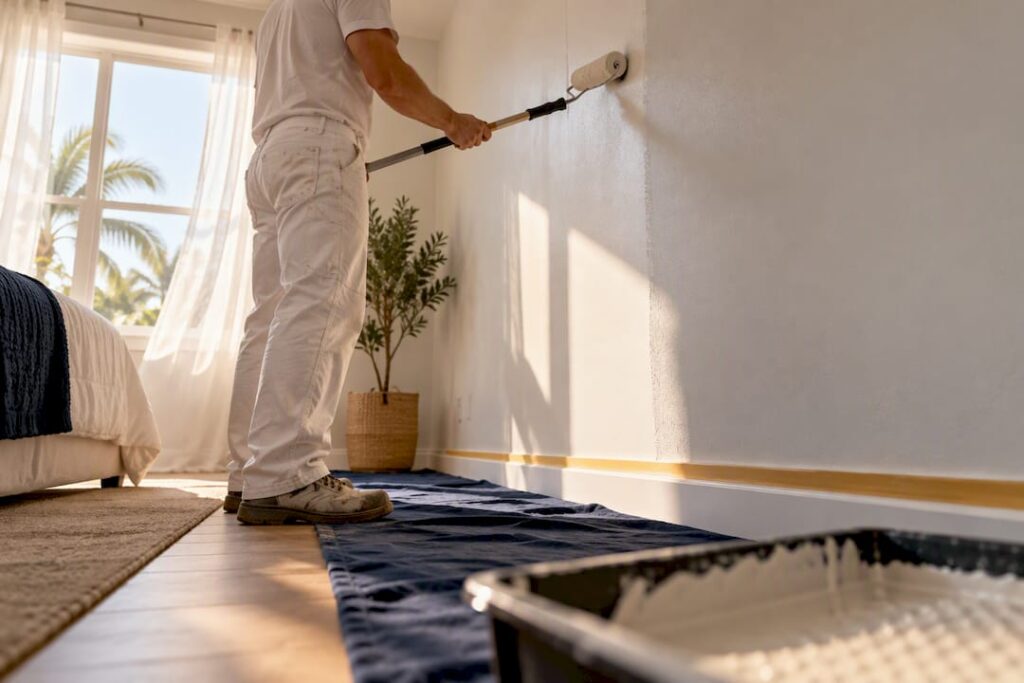
Low-VOC paint cuts the chemical fumes released into your home during and after a repaint, which means less odor, fewer irritated eyes and airways, and rooms you can safely use again sooner. Choosing a certified product, checking the tinting, and running proper ventilation are what turn that potential into a real, measurable improvement in indoor air. There are trade-offs in cost and coverage, but for most occupied-home projects, the benefits outweigh them.
TL;DR:
- Low-VOC paints significantly reduce indoor air pollution by emitting fewer volatile compounds during and after application, enabling faster room reoccupation.
- Most low-VOC products are water-based, easier to clean, and often meet the same durability standards as traditional paints, though some may require extra coats.
- Tinted low-VOC paints can exceed VOC limits due to colorant additives, so selecting products with restricted colorant VOCs is crucial for true low-emission benefits.
- Proper ventilation, use of certified products, and avoiding untested “low-odor” claims are essential for ensuring health and safety during and after painting projects.
- Occupied-home projects benefit from careful planning, including product review, room-by-room scheduling, and ventilation, to minimize exposure and environmental impact.
Table of Contents
- The Practical Benefits of Choosing Low-VOC Paint
- How Low-VOC Paint Affects Air Quality and Your Health
- Performance, Durability, and What You Actually Pay For
- How to Choose a Low-VOC Paint You Can Trust
- How Elite Builder Renovation Handles Low-Emission Painting
- Environmental Impact: Low-VOC Versus Conventional Paint
- Where Traditional Paint’s VOCs Actually Come From
- When Low-VOC Paint Might Not Be the Right Call
- Keeping a Low-VOC Paint Job Looking Good Longer
- Ready for a Low-Emission Repaint in Tampa Bay?
- Sources
- FAQ
The Practical Benefits of Choosing Low-VOC Paint
Homeowners in Tampa Bay repaint for a lot of reasons: a kitchen refresh before selling, storm damage touch-ups, or just getting tired of builder-grade beige. Whatever the reason, the paint you choose affects more than the wall color. It affects the air your family breathes for days afterward.
Low-VOC formulations trade heavy solvents for water-based carriers, and that swap shows up in five concrete ways:
- Cleaner indoor air. Fewer volatile compounds evaporate into the room during application and while the paint cures, which lowers the concentration of airborne chemicals you and your family are exposed to.
- Minimal odor. The sharp, chemical smell that used to force families out of the house for a weekend is far weaker, which makes painting an occupied bedroom or nursery realistic instead of a scheduling headache.
- Faster reoccupation. Rooms painted with low-VOC products generally clear out to comfortable air quality sooner than rooms painted with standard solvent-based paint, especially with a window cracked and a fan running.
- A smaller environmental footprint. Fewer VOCs released outdoors means less contribution to ground-level ozone formation, a concern the EPA’s architectural coatings regulation was specifically written to address.
- Easier cleanup. Most low-VOC paints are water-based, so brushes and rollers rinse clean with soap and water instead of requiring mineral spirits.
Pro Tip: If you’re painting a nursery, home office, or a room where someone spends eight or more hours a day, prioritize a certified low-VOC or zero-VOC product even if the rest of the house gets a standard-grade paint. Exposure adds up with time spent in the room, not just proximity to the can.
None of this means every “low-VOC” can on the shelf performs the same. The EPA’s own architectural coatings framework exists because formulations vary widely by manufacturer and region, and state-level rules can push companies toward different VOC limits depending on where the product ships.
How Low-VOC Paint Affects Air Quality and Your Health
Volatile organic compounds are carbon-based chemicals that evaporate at room temperature, and paint has historically been one of the biggest indoor sources of them. According to the EPA’s technical overview of VOCs, indoor concentrations are routinely higher than what you’d find outside, sometimes dramatically so during and right after a paint job.
That matters because VOC exposure isn’t just an unpleasant smell. Short-term, high-level exposure is linked to headaches, dizziness, and irritation of the eyes, nose, and throat. Children, older adults, and anyone with asthma or COPD are more sensitive to these effects, which is a real consideration if you’re repainting a home with a newborn or an elderly parent in residence. A 2024 systematic review and meta-analysis of paint-industry workers found significantly higher odds of cough, dyspnea, throat irritation, and wheeze among those with occupational VOC exposure, along with measurably reduced lung function. Occupational exposure runs far higher than what a homeowner encounters during a weekend repaint, but the underlying mechanism is the same chemistry, just at a smaller dose.
The numbers behind the “low-VOC” label are worth knowing. Green Seal’s guidance sets flat paints under 50 grams per liter as low-VOC, while zero or “no-VOC” untinted bases fall under 5 g/L. Nonflat finishes like eggshell or satin often carry a slightly higher threshold, around 100 g/L. Here’s where a lot of homeowners get surprised:
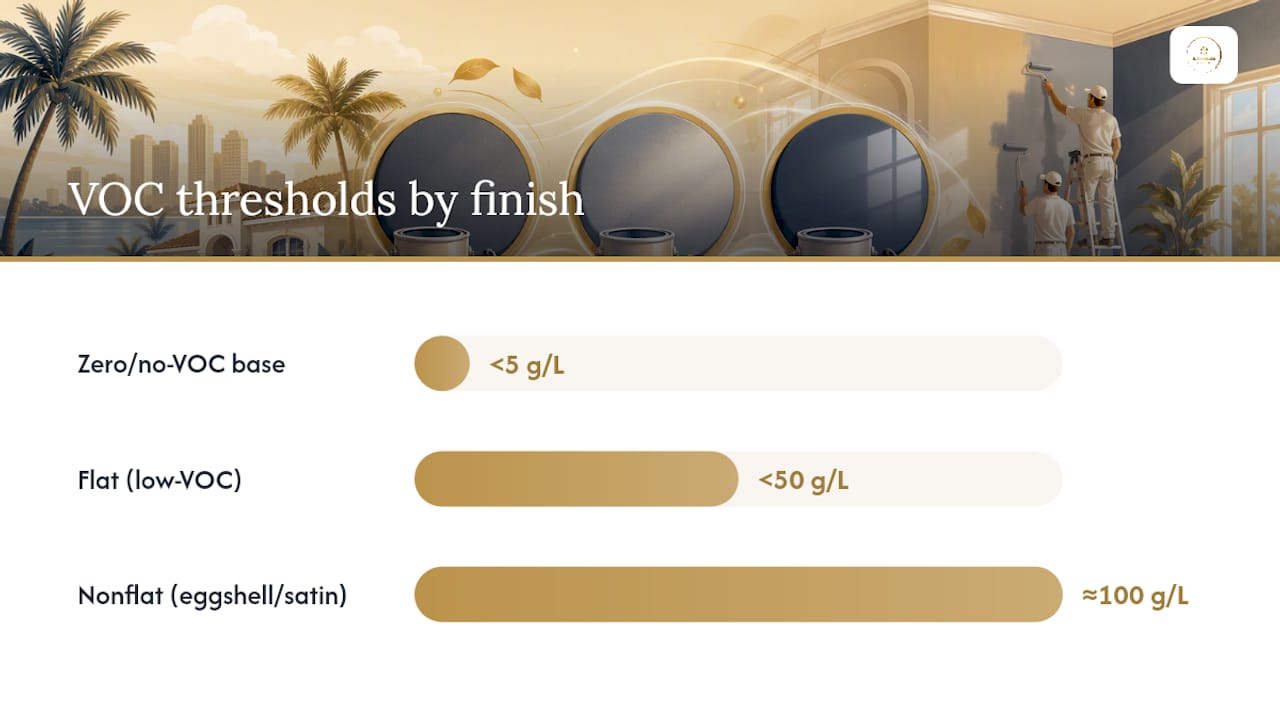
The tinting caveat matters most here: adding colorant at the store can push a technically “zero-VOC” base well above its labeled threshold, since colorants aren’t always covered by the same limit. Look for products where Green Seal restricts colorant VOCs specifically, not just the base.
For any paint job, ventilate before, during, and for several days after application, open windows, run exhaust fans, and consider a portable air purifier in the room as explained in our guide on how to prepare your home for a drywall and painting project. Anyone doing the actual painting should wear a properly rated respirator mask, not just a cloth covering, especially in a small bathroom or closet with limited airflow.
Performance, Durability, and What You Actually Pay For
The old complaint about low-VOC paint, that it didn’t cover as well or hold up as long as solvent-based formulas, has largely faded as manufacturers have improved their chemistry. Modern low-VOC and zero-VOC products from reputable lines routinely meet the same scrubbability and fade-resistance standards as traditional paint, though performance still varies by brand and specific product line.
A few realities are worth setting expectations around before you buy:
- Some low-VOC paints need an extra coat for full coverage, particularly with darker base colors or when covering a drastic color change.
- Material cost per gallon tends to run higher for certified low-VOC products, though the premium is usually modest compared to the total cost of a room repaint, especially once you factor in labor.
- The VOC number on the can doesn’t capture every hazardous ingredient. EPA lab testing has found that some products labeled low-VOC still emit measurable amounts of formaldehyde and acetaldehyde, so the number alone isn’t the whole emissions story.
- Always test a small patch first, and ask for the scrubbability rating or a Green Seal/GREENGUARD performance sheet before committing an entire house to one product line.
For most Tampa Bay homes, the durability gap that used to justify skipping low-VOC paint just doesn’t hold up anymore. If you want finish-specific guidance, our interior paint finish guide breaks down which sheens perform best in high-humidity Florida rooms like bathrooms and kitchens.
How to Choose a Low-VOC Paint You Can Trust
Reading a paint can label is trickier than it looks, because “low-odor” and “low-VOC” are not interchangeable claims, and neither guarantees a product was independently tested. Here’s a practical sequence to follow before you buy:
- Check the technical data sheet, not just the front label. Look for the actual VOC content in grams per liter, not a marketing phrase.
- Prefer Green Seal or GREENGUARD-certified products. These third-party programs test actual emissions, not just formulated VOC content, which is a more reliable indicator of what ends up in your air.
- Ask about colorant VOC limits. A zero-VOC base tinted with an unrestricted colorant can end up far from “zero” once it’s in the can.
- Request the safety data sheet (SDS). Any reputable paint supplier or contractor should hand this over without hesitation.
- Plan ventilation and timing before the first coat goes on, not after you notice a headache. If you’re living in the home during the project, coordinate room-by-room scheduling so painted spaces have time to air out before you move back in.
- Ask your contractor what products they use by default and whether they can source certified options for sensitive rooms like bedrooms or nurseries.
Pro Tip: Walk away from any product where “low-odor” is the only claim on the front label with no VOC number anywhere on the can or data sheet. Odor and VOC content are related but not the same thing, and a manufacturer hiding the number usually means it’s not flattering.
Leftover paint should go to a household hazardous waste facility rather than the trash or storm drain; most Pinellas County and Hillsborough County waste programs accept it free of charge. If your project involves broader material choices beyond paint, our eco-friendly renovation materials guide covers flooring, insulation, and cabinetry options that pair well with a low-emission painting plan.
How Elite Builder Renovation Handles Low-Emission Painting
Over more than a decade and 375-plus completed projects across Tampa, St. Petersburg, Clearwater, Largo, and Safety Harbor, we’ve learned that painting an occupied home takes more planning than painting an empty one. Product choice is only half the equation. The other half is sequencing the work so families aren’t breathing fumes in a room they still need to sleep in that night.
Our process on repaint and remodel projects generally includes:
- Reviewing product data sheets and SDS documents before recommending a paint line, not just relying on the label.
- Building a room-by-room ventilation plan, including fan placement and drying windows, before the crew opens a single can.
- Scheduling occupied-space work around when residents are away, when practical, to reduce direct exposure during application.
- Coordinating with our interior and exterior painting services team so paint selection lines up with the rest of a kitchen, bathroom, or full-home remodel timeline.
If ventilation or HVAC airflow is a concern in a larger commercial repaint, our piece on why HVAC matters in every commercial remodel covers how mechanical systems interact with indoor air quality during a project.
Environmental Impact: Low-VOC Versus Conventional Paint
The environmental case for low-VOC paint is separate from the health case, though the two overlap. Conventional solvent-based paints release VOCs that react with sunlight and nitrogen oxides to form ground-level ozone, a major component of smog and a regulated pollutant under EPA’s architectural coatings rule. That rule exists specifically because paint has historically been one of the largest VOC-emitting product categories nationwide.
Low-VOC formulations reduce this outdoor impact simply by releasing fewer solvents into the atmosphere during application and curing, both indoors and out. On a single house, the difference is small. Across a metro area, it adds up, which is why the EPA regulation targets manufacturers rather than individual buyers.
There’s a secondary environmental benefit that gets less attention: water-based low-VOC paints generally require less harsh solvent for cleanup, meaning less mineral spirits and thinner going down drains or into landfills via disposal. For homeowners who care about the footprint of a renovation beyond the paint can itself, that’s a real, if modest, reduction in the chemical load a project sends into local waterways and waste systems, a relevant consideration anywhere in Pinellas County or Hillsborough County given the proximity to Tampa Bay’s waterways.
Where Traditional Paint’s VOCs Actually Come From
Most VOCs in conventional paint come from three places: the solvent base itself, additives that control drying time and texture, and preservatives that extend shelf life. Older oil-based and alkyd paints relied heavily on petroleum-derived solvents to keep pigment suspended and to control how the paint leveled on a wall, and those solvents are exactly what evaporates into your air as the paint dries.
Documentation on occupational paint exposure from the NCBI Bookshelf traces this shift clearly: the paint industry has moved substantially toward water-based carriers and lower-toxicity solvents over the past few decades, driven by both regulation and consumer demand. Low-VOC formulations reduce emissions by replacing those solvent bases with water as the primary carrier, and by using additives that achieve similar performance (drying time, leveling, adhesion) without the same volatile chemistry.
Preservatives and mildewcides, common in humid climates like ours, are a smaller but real contributor too. Reformulated low-VOC versions of these additives exist, but they’re not universal, so a “low-VOC” bathroom paint marketed for mold resistance is worth double-checking against its technical data sheet rather than assuming the lower solvent content extends to every ingredient.
When Low-VOC Paint Might Not Be the Right Call
Low-VOC paint isn’t automatically the best choice in every situation, and pretending otherwise does homeowners a disservice. A few scenarios where trade-offs deserve real consideration:
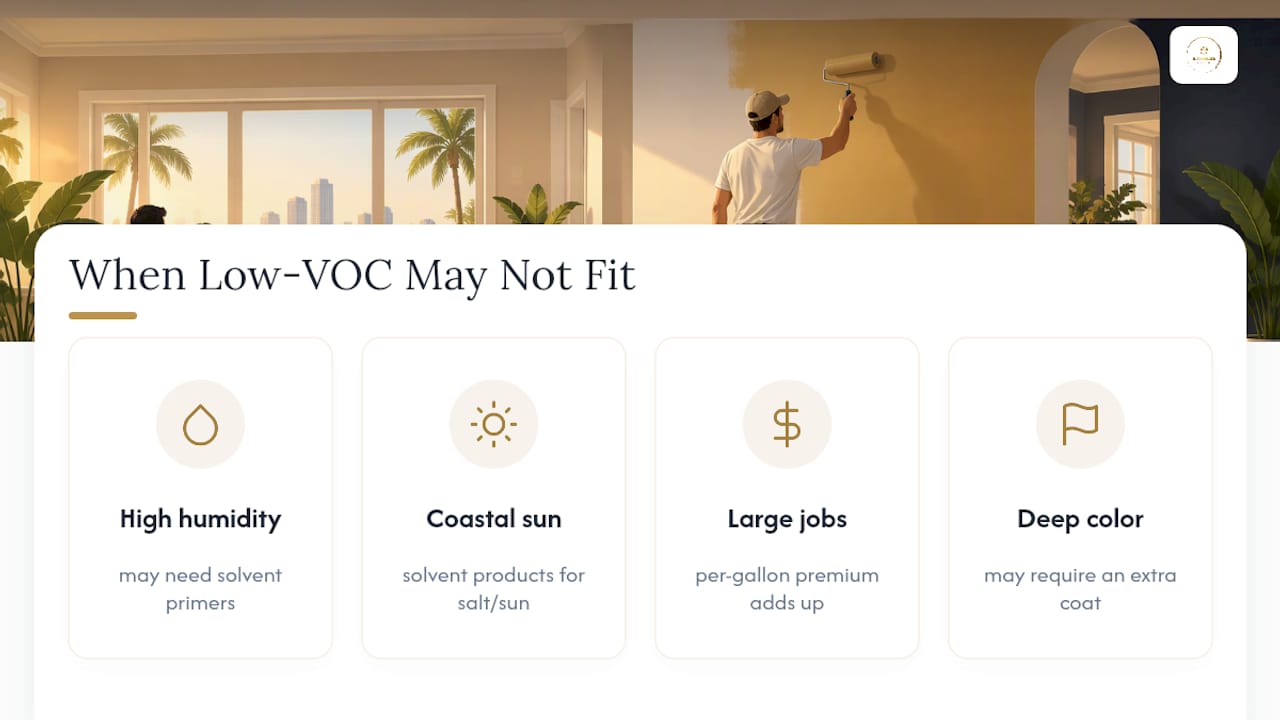
Extremely high-humidity environments, like a poorly ventilated bathroom or a garage without climate control, sometimes benefit from specialty solvent-based primers or mildew-resistant coatings that don’t yet have a fully equivalent low-VOC version with the same track record. Exterior surfaces exposed to intense Florida sun and salt air occasionally call for a specific solvent-based product engineered for that exposure, where the low-VOC alternative hasn’t been tested as extensively in the field.
Budget-constrained projects covering large square footage, like a full exterior repaint on a commercial building, may find the modest per-gallon premium adds up meaningfully at scale, even though it’s minor on a single room. And extremely deep color changes, going from a dark accent wall to white, for instance, sometimes need an extra coat of low-VOC paint to fully cover, which affects both cost and timeline. None of these are reasons to abandon low-VOC paint outright. They’re reasons to have a candid conversation with your contractor about the specific surface, climate exposure, and budget before assuming one product fits every wall in the house.
Keeping a Low-VOC Paint Job Looking Good Longer
Low-VOC paint doesn’t need a fundamentally different maintenance routine than standard paint, but a few habits extend its life and keep indoor air benefits intact. Clean walls with a mild soap and soft cloth rather than harsh solvent-based cleaners, which can strip the finish faster on some water-based formulations than they would on old-school alkyd paint.
Touch-ups matter more with low-VOC paint than people expect. Because many of these products cure through evaporation of water rather than a chemical hardening reaction, a touch-up applied months later can sometimes show a slight sheen or texture difference if the original can wasn’t stored properly. Keep a labeled, sealed sample of your paint color and batch number for at least a year after the job, and store it somewhere temperature-stable, not a hot garage in a Tampa summer.
Humidity is the bigger long-term threat in this climate. Bathrooms, laundry rooms, and any space near the coast benefit from a dedicated mold-resistant low-VOC formulation and consistent exhaust fan use, since moisture is what actually breaks down paint film over time, not the VOC content itself. Handled this way, a certified low-VOC paint job holds its finish just as long as a comparable standard paint job would.
Ready for a Low-Emission Repaint in Tampa Bay?
A professional low-emission paint job means less disruption to your daily routine and fewer fumes lingering in the rooms your family actually uses. Elite Builder Renovation reviews product data sheets, plans ventilation room by room, and schedules work around occupied spaces so you’re not choosing between a fresh coat of paint and a comfortable house that week.
We offer free consultations, financing options, and a 100% satisfaction guarantee across every project, whether it’s a single-room repaint or part of a larger full home remodeling project. Our painting crews work throughout Tampa, St. Petersburg, Clearwater, Largo, Safety Harbor, and the surrounding Pinellas County and Hillsborough County communities. If low VOC paint benefits matter to your family’s next project, start with our interior and exterior house painting services page, or reach out through Elitebuilderrenovation to schedule a consultation and get a plan built around your home and your timeline.
This article is general information, not a substitute for advice from a qualified doctor. Consult a qualified healthcare professional about your own circumstances before acting on anything here.
Sources
- Your Guide to VOCs in Paint and Cleaning Products – Green Seal
- Respiratory symptoms and pulmonary function in paint industry workers exposed to volatile organic compounds: A systematic review and meta-analysis
- EPA technical report on emissions and performance of low‑VOC paints
- EPA: Architectural coatings regulation and compliance guidance
FAQ
What Are the Benefits of Low-VOC Paint?
Low-VOC paint releases fewer volatile chemicals into the air during and after application, which means less odor, reduced irritation risk for sensitive household members, and a smaller contribution to outdoor ozone formation. Certified products, as defined by Green Seal’s thresholds, also tend to allow faster reoccupation of a freshly painted room.
Is It Okay to Sleep in a Room With Low-VOC Paint?
Once a room has been ventilated for a day or two with windows open and fans running, sleeping there is generally considered reasonable for most healthy adults. Anyone with asthma, COPD, or heightened chemical sensitivity should wait longer and confirm the odor has fully cleared, since even low-VOC products emit some compounds during the initial cure period, as noted in EPA’s indoor air guidance.
Do I Really Need to Worry About VOCs From Paint?
For a single small room repainted occasionally, the health risk is far lower than what occupational studies measure in painters exposed daily over years, so it’s not a reason to panic. It’s still worth reducing exposure where it’s easy to do, since children, older adults, and anyone with respiratory conditions are more sensitive to even modest VOC levels.
How Do I Know If a Paint Is Actually Low-VOC?
Check the technical data sheet for the VOC content in grams per liter rather than trusting a “low-odor” claim on the front label. Products certified by Green Seal or tested under GREENGUARD’s indoor emissions program carry independently verified numbers instead of self-reported marketing language.
Does Elite Builder Renovation Use Low-VOC Paint on Projects?
Our team reviews product data sheets and builds a ventilation plan before starting any interior painting work, prioritizing certified low-emission products on occupied-home projects. Pricing for painting services is available by request through a free consultation at Elitebuilderrenovation.