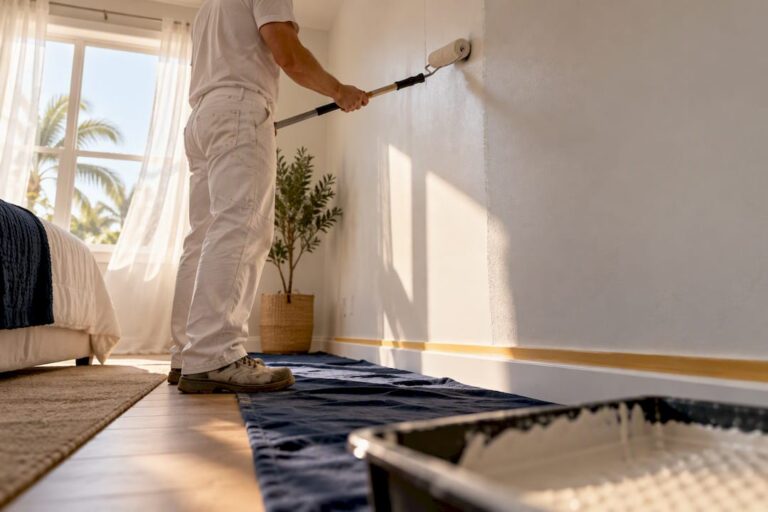


Use flat or matte on ceilings, eggshell or satin for most living-area walls, and satin or semi-gloss for kitchens, bathrooms, trim, and cabinets. That’s the short answer. Every sheen decision comes down to one trade-off: higher gloss cleans easier and resists moisture, but it also reflects light and shows every ripple, patch, and roller mark on your walls. Lower sheen hides those flaws but wears faster in busy spots. This interior paint finish guide breaks down where each sheen level belongs, using the same logic Elite Builder Renovation’s painting crews apply on remodel jobs across Tampa Bay.
Quick picks by surface:
- Ceilings: Flat or matte, always, unless it’s a bathroom with poor ventilation.
- Bedrooms and living rooms: Eggshell for a soft look, satin if kids or pets add daily wear.
- Kitchens and bathrooms: Satin or semi-gloss, with a mildew-resistant formula in wet rooms.
- Trim, doors, and cabinets: Semi-gloss for durability, satin for a subtler, less “plasticky” look.
Key Takeaways
The right interior paint finish balances how much wear a surface takes against how much it needs to hide imperfections, with flat for ceilings, eggshell or satin for living spaces, and semi-gloss for trim, cabinets, and wet rooms.
| Point | Details |
|---|---|
| Sheen equals durability trade-off | Higher sheen resists moisture and cleans easier but exposes wall flaws under light. |
| Ceilings stay flat | Flat or matte hides texture and avoids glare from overhead fixtures in nearly every room. |
| Wet rooms need denser film | Bathrooms, laundry rooms, and basements do best in satin or semi-gloss with mildew-resistant chemistry. |
| Trim goes one step up | Pick a trim sheen one level above the wall sheen for visual definition and durability. |
| Prep work drives results | Elite Builder Renovation applies contractor-grade prep and two-coat application on every high-sheen surface it paints. |
Table of Contents
- What Sheen Actually Means and Why It Drives Every Decision
- Which Paint Sheen Should You Use in Each Room?
- How Do You Choose the Right Finish for a Specific Wall?
- Getting Trim, Cabinets, and Ceilings Right
- What Our Remodeling Projects Have Taught Us About Paint Sheen
- Are Some Paint Finishes Better for Indoor Air Quality?
- Where Elite Builder Renovation Fits Into Your Painting Project
- Sources
- FAQ
What Sheen Actually Means and Why It Drives Every Decision
Sheen is a measurement of light reflectance, not a marketing label. Paint manufacturers test how much light bounces off a dried film at a fixed angle, and that number determines whether a can gets labeled flat, eggshell, satin, semi-gloss, or high gloss. The industry-standard reference point for this comes from the Master Painters Institute (MPI), which grades sheen levels so contractors can compare products across brands with some consistency. That consistency has limits, though: Behr notes that one manufacturer’s “eggshell” isn’t guaranteed to match another’s, so always check the sheen percentage on the can rather than trusting the name alone.
The mechanism behind sheen is resin and binder content. More resin means a denser, harder paint film once it cures.
That density is why higher-sheen paints clean up better and resist moisture more effectively than flat paint, but it comes at a cost: the same density that repels a grease splatter also reflects light straight back at whoever’s looking at your drywall seams.
Flat paint absorbs light instead of bouncing it, which is exactly why it disguises texture, tape lines, and old patch jobs so well.
Here’s what changes the old rulebook: modern “durable matte” and cross-linking paint technologies now let manufacturers build washability into low-sheen products. Sherwin-Williams’ durable matte lines resist burnishing and scrub better than traditional flat paint did a decade ago, though they still won’t outperform semi-gloss in a shower surround. Sheen also shapes how a color reads in a room. The same blue looks moodier and more saturated in flat, and slightly cooler and more reflective in satin, because glossier films scatter ambient light differently across the wall.
Quick sheen spectrum, low to high:
- Flat/matte: Lowest sheen, best flaw-hiding, most porous.
- Eggshell: Slight sheen, most popular all-purpose wall finish.
- Satin: Soft glow, noticeably more washable than eggshell.
- Semi-gloss: Strong reflection, standard for trim and wet areas.
- High gloss: Mirror-like finish, reserved for accents and cabinetry.
Which Paint Sheen Should You Use in Each Room?
Every room in your home puts different demands on a paint film: some get scrubbed daily, some sit in humidity, some just need to look good under a chandelier. Apartment Therapy’s room-by-room breakdown mirrors what we see on remodel sites across Pinellas and Hillsborough County: the finish that survives a kid’s bedroom is rarely the one you’d choose for a hallway.
| Room or surface | Recommended sheen | Why it works |
|---|---|---|
| Ceilings | Flat/matte | Hides seams and texture, minimizes glare |
| Living/dining rooms | Eggshell | Balances a soft look with light wipe-down ability |
| Bedrooms | Eggshell or flat | Low traffic, prioritizes a smooth, non-reflective look |
| Kids’ rooms | Satin | Handles marker and handprint scrubbing better than eggshell |
| Hallways | Satin | Higher traffic than most rooms, needs extra durability |
| Kitchen walls | Satin or semi-gloss | Resists grease, steam, and repeated cleaning |
| Backsplash-adjacent walls | Semi-gloss | Direct splatter zone needs maximum washability |
| Bathrooms (good ventilation) | Satin | Mid-range moisture resistance without excess glare |
| Bathrooms (poor ventilation) | Semi-gloss, mildew-resistant | Extra moisture load demands a denser film |
| Laundry rooms | Satin or semi-gloss | Frequent water exposure and spills |
| Basements | Satin, mildew-resistant | Ambient humidity risk even without visible leaks |
| Sunrooms | Eggshell or satin | UV exposure and glare call for a mid-sheen balance |
| Trim and doors | Semi-gloss | Handprints, kicks, and door swings need a hard film |
| Cabinets | Semi-gloss or satin waterborne alkyd | Maximum daily contact demands the hardest finish available |
Bathrooms are the one room where ventilation changes the answer more than aesthetics do. Behr’s guidance on mildew-resistant chemistry is worth following closely if your bathroom lacks a strong exhaust fan or gets long, steamy showers daily.
Pro Tip: If you’re painting a kitchen or bathroom, look for the words “kitchen & bath” or “mildew-resistant” on the can label, not just the sheen name. Some durable-matte lines now carry that protection at a lower sheen, which is a good option if you want washability without the glare of semi-gloss.
How Do You Choose the Right Finish for a Specific Wall?
Four factors decide sheen for any single wall or room, and running through them takes less time than picking a paint color.
- How often does this surface get touched? High-contact zones (hallways, kids’ rooms, kitchens) push you toward satin or semi-gloss. Low-contact zones (formal living rooms, ceilings) can stay flat or eggshell.
- How much moisture or humidity does the room see? Anything above occasional splashes, showers, steam, laundry, and basements, needs at least satin, ideally mildew-resistant.
- How does light hit the wall? A wall that catches strong raking light from a window will show every roller mark in satin or semi-gloss. Flatter sheens are more forgiving here.
- What’s the substrate condition? Old patch jobs, orange-peel texture, or uneven drywall mudding will telegraph through anything above eggshell.
Before committing a whole room, paint two 2 foot by 2 foot swatches directly on the wall using your top two sheen candidates. View both in daylight and again at night under your normal lighting; a satin that looks fine at noon can turn distractingly shiny under a table lamp at raking angles.
For execution, prime bare or patched drywall, sand rough spots smooth, and plan on two full coats. Benjamin Moore’s guidance confirms two coats as the baseline for even sheen and color, even on products labeled for one-coat coverage.
Pro Tip: If the project involves cabinets, high-gloss trim, or a full room repaint tied to a larger remodel, it’s usually worth bringing in a contractor. The prep work for a flawless semi-gloss finish is far less forgiving of shortcuts than a flat ceiling.
Getting Trim, Cabinets, and Ceilings Right
Trim and doors follow what painters call the “one step up” rule: pick a sheen one level above your wall sheen to create visual separation. Flat walls pair well with eggshell or satin trim; eggshell walls usually move up to satin or semi-gloss trim. Sand lightly between coats and prime bare wood or repaired sections before topcoating, especially on doors that get handled daily. If you’re deciding between finishes for a door specifically, One Day Doors & Closets breaks down the visual trade-offs between satin and semi-gloss in more detail.
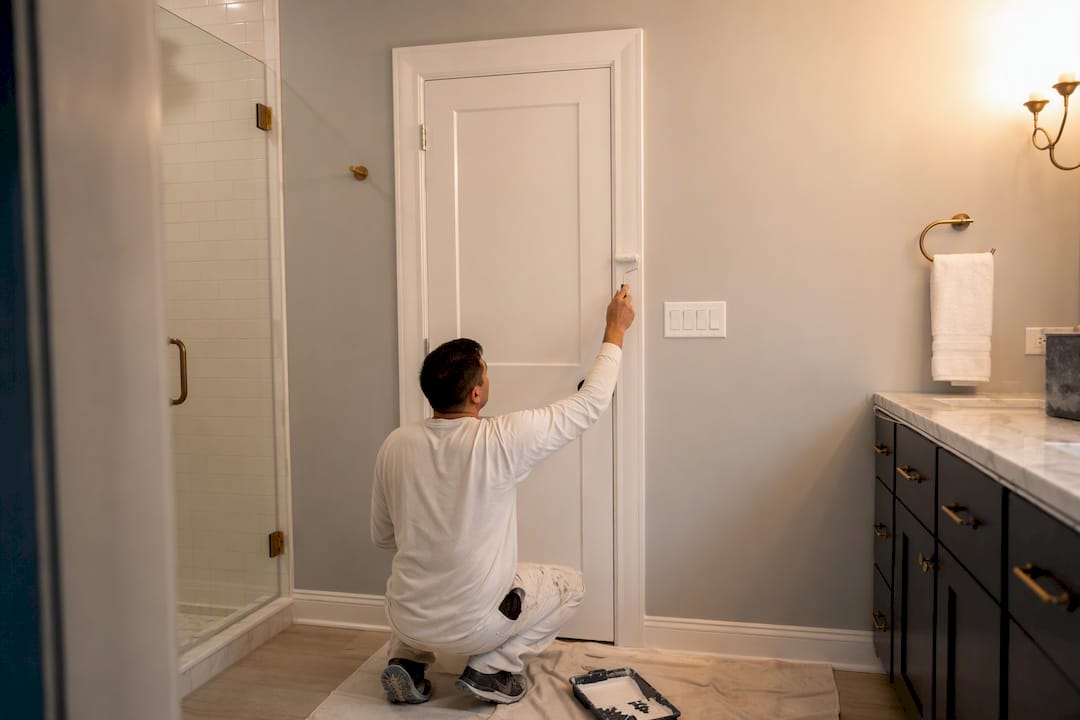
Cabinets take more preparation than any other interior surface. A waterborne alkyd in satin or semi-gloss gives you oil paint’s smooth, hard leveling with the easy soap-and-water cleanup of latex, which is why it’s become the standard contractor choice for a furniture-grade cabinet finish. Expect degreasing, deglossing, and light sanding before primer goes on; skipping that step is the number one reason DIY cabinet jobs peel within a year.
Ceilings stay flat almost everywhere in the house, since the goal is hiding texture and avoiding glare from overhead light fixtures. The exception is a poorly ventilated bathroom ceiling, where a flat mildew-resistant formula protects against the moisture that rises straight off a hot shower.
Textured or recently patched walls need extra caution: any sheen above eggshell will magnify lap marks and sanding swirls, so budget time for a proper skim coat and full sanding pass before the topcoat goes on.
What Our Remodeling Projects Have Taught Us About Paint Sheen
Elite Builder Renovation has completed numerous projects across Tampa Bay, and paint sheen mistakes show up on a predictable list: semi-gloss walls in a room with harsh window light, flat paint in a laundry room that develops mildew within a year, or cabinets painted without proper degreasing. Two full coats and contractor-grade prep aren’t optional extras on high-sheen surfaces; they’re what keeps semi-gloss and satin from looking patchy six months later.
- Premium waterborne alkyd cabinet finishes tend to offer better cure hardness and chip resistance compared to standard finishes.
- Cabinet finishes often require a cure period between coats, which can extend kitchen project timelines.
- If paint is part of a larger remodel involving drywall or structural changes, check with your municipality on permit requirements before work begins.
If you’d rather have a crew handle the sheen selection, prep, and application, our interior and exterior painting services cover exactly this kind of work, and our interior renovation guide walks through how paint fits into a broader remodel timeline.
Are Some Paint Finishes Better for Indoor Air Quality?
Sheen level and chemical composition are two different things, but they’re related enough to matter. Higher-sheen paints generally use more synthetic resin, and some of those resins historically carried higher volatile organic compound (VOC) content than flat, water-based formulas. Most major manufacturers now offer low-VOC or zero-VOC versions across the full sheen range, from flat through semi-gloss, so you’re no longer forced to choose between air quality and durability the way homeowners were a decade ago.
Ventilation matters more than sheen choice during application itself. Open windows, run exhaust fans, and avoid sleeping in a freshly painted room for at least 24 to 48 hours, regardless of which sheen you’re using. Mildew-resistant formulations, common in bathroom and basement products, contain additional biocides designed to prevent mold growth in humid conditions. Those additives are a health benefit in a damp Florida bathroom, since they reduce the mold spores that trigger allergies and respiratory irritation.
If you have small children, pets, or anyone with chemical sensitivities in the home, look specifically for “low-VOC” or “zero-VOC” on the label rather than assuming a flat finish is automatically the safer choice. Some flat paints still carry standard VOC levels, while some semi-gloss lines are now formulated zero-VOC. Reading the can matters more than guessing based on sheen name alone.
Where Elite Builder Renovation Fits Into Your Painting Project
Picking the right sheen is only half the job. Getting a flawless semi-gloss finish on cabinets or a durable satin coat on bathroom walls that don’t hold color evenly depends on prep work most homeowners underestimate: degreasing, sanding, priming, and applying coats at the right intervals. Elite Builder Renovation has built that process into every remodel across Tampa, St.
Whether you’re repainting a single kitchen or coordinating paint sheen choices across a full home renovation, our team handles the sheen selection, surface prep, and application so the finish looks right under every light in the house, not just the showroom lighting. You can browse real client feedback on our remodeling reviews page to see how past projects turned out, and when you’re ready to move forward, request a free consultation through our Tampa home remodeling page to get a project timeline and quote started.
Sources
Room and sheen recommendations here draw on Kilz’s sheen breakdown for washability and hardness, Sherwin-Williams’ finish guide for reflectance and flaw visibility, Benjamin Moore’s finish comparisons for cabinet and trim guidance, and Behr’s sheen selection resource for mildew-resistant recommendations in wet rooms.
- What are paint sheens and what’s the difference? | Kilz
- How to Choose a Paint Finish | Benjamin Moore
- Selecting interior paint sheens | Behr
FAQ
What Are the 5 Types of Interior Paint Finishes?
The five common finishes are flat/matte, eggshell, satin, semi-gloss, and high gloss, ranked from lowest to highest light reflectance and durability.
What Sheen Should Interior Walls Be?
Most living-area walls do best in eggshell or satin, since both offer a soft appearance while resisting scuffs and light cleaning better than flat paint.
Should My Walls Be Eggshell or Satin?
Choose eggshell for lower-traffic rooms like formal living rooms and bedrooms, and satin for hallways, kids’ rooms, or any wall that gets wiped down regularly.
What Order Do Paint Sheens Go In?
From lowest to highest sheen: flat/matte, eggshell, satin, semi-gloss, and high gloss, with washability and light reflectance increasing at each step.
Is It Worth Hiring a Contractor for a High-Gloss Finish?
High-gloss and semi-gloss finishes magnify surface flaws, so contractor-grade sanding and priming make a visible difference. Elite Builder Renovation applies that level of prep on every cabinet and trim project it takes on across Tampa Bay.