

A commercial renovation warranty is a contractual assurance that renovation work and materials meet specified standards and will remain free from defects for defined periods, typically starting at practical completion. Property owners and managers often treat this warranty as a single promise from their contractor. In reality, it is a layered set of overlapping obligations covering different defect types, durations, and responsible parties. Understanding renovation warranties fully means knowing which layer applies when something goes wrong, who is responsible for fixing it, and how long your protection actually lasts.
What are the key types of warranties in commercial renovations?
Commercial renovation warranties are not a single document. They are multiple overlapping obligations covering different types and durations, and treating them as one promise is the most common mistake property owners make.
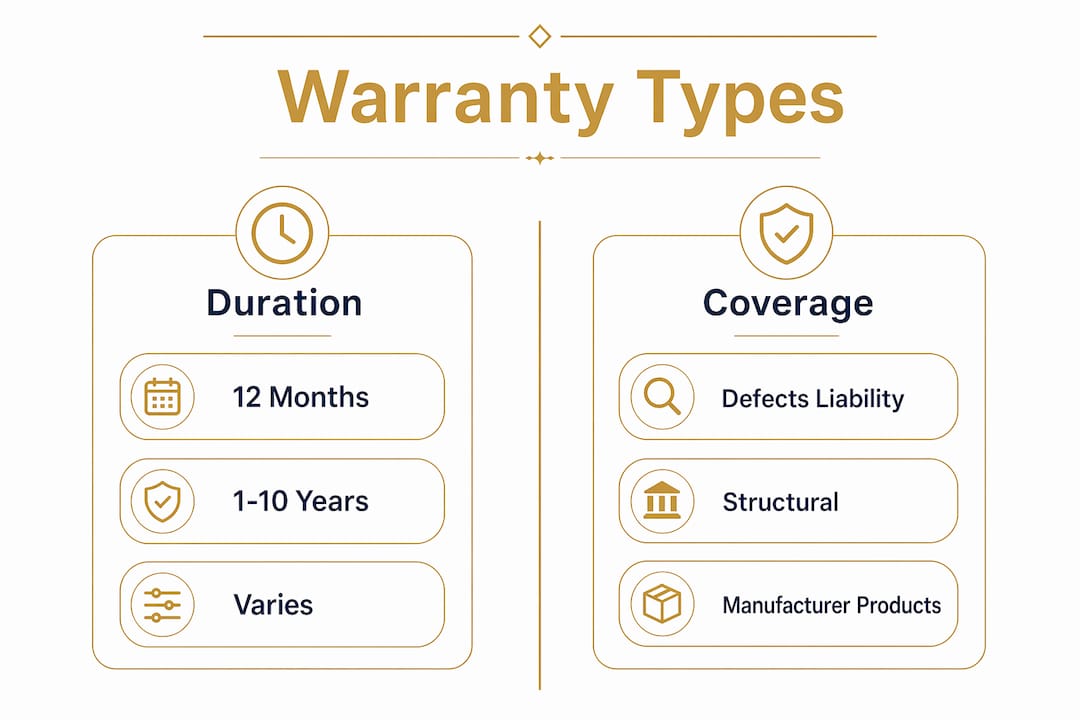
The three core warranty layers are:
- Defects liability period (DLP). This is the contractor’s short-term obligation to remedy faulty workmanship or materials. The defects liability period is typically 12 months from practical completion. Defects must be notified in writing, and the contractor usually has 10 working days to fix them. A defects certificate is issued at the end of this period.
- Product and manufacturer warranties. These cover specific installed components such as roofing systems, HVAC units, flooring, and glazing. Durations vary widely, from 1 year for basic finishes to 15 years for certain structural products. These warranties run independently of the contractor’s DLP.
- Structural warranties. A commercial structural warranty covers latent structural defects not visible at handover, typically for 10 years, and focuses on core load-bearing elements. It excludes wear and tear and cosmetic issues.
A fourth layer, collateral warranties, gives third parties such as tenants or lenders direct contractual rights against the contractor or design team. Latent defects insurance can run 5–15 years after completion and provides coverage when a contractor is insolvent or no longer trading.
| Warranty type | Typical duration | What it covers |
|---|---|---|
| Defects liability period | 12 months | Faulty workmanship and materials |
| Product/manufacturer warranty | 1–15 years | Specific installed components |
| Structural warranty | 10 years | Latent structural defects |
| Latent defects insurance | 5–15 years | Hidden defects post-contractor failure |
| Collateral warranty | Varies by contract | Third-party rights against contractor |

Pro Tip: Request copies of all manufacturer warranties at handover and store them alongside your building contracts. Many property owners discover too late that product warranties were never formally passed through to them.
How do practical completion and defects liability periods work?
Practical completion is the contractual milestone that starts your warranty clock. Practical completion means the works are substantially complete and fit for their intended purpose, even if minor tasks remain outstanding. The exact definition varies by contract, and that ambiguity is a frequent source of disputes.
Here is how the sequence works in practice:
- Practical completion is certified. The contract administrator or project manager issues a practical completion certificate. This date is critical because it starts the defects liability period and often triggers the release of part of the contractor’s retention payment.
- The defects liability period begins. From this date, the contractor is obligated to return and fix any defects that emerge. The standard period is 12 months, though some contracts extend this to 24 months for complex fit-outs.
- Snagging and defect identification. Snagging refers to minor incomplete items noted at handover. Major defects that emerge after occupation are separate and must be formally notified in writing. Confusing snagging with post-occupation defects is a common documentation error.
- Retention release and final certificate. The final retention payment is typically released only after the defects liability period ends and a final certificate is issued. Retention and snagging sign-off are directly linked, so unresolved defects can delay final payment release on both sides.
- End of defects liability period. The contractor’s obligation to return and fix defects ends here. After this point, you rely on structural warranties, product warranties, and any insurance policies in place.
Pro Tip: Ambiguity in defining practical completion often causes disputes that delay the defects liability period and complicate warranty claims. Negotiate a clear, written definition of practical completion into your contract before work begins.
Warranty coverage is set across multiple documents including fit-out agreements, building contracts, and collateral warranty insurance. Contract clarity about practical completion and defect remedies is not optional. It is the foundation of every claim you may need to make.
What protections exist beyond the contractor’s defects period?
Relying solely on the contractor’s defects liability period leaves significant gaps in your protection. Once the DLP ends, or if the contractor becomes insolvent, you need other mechanisms in place.
The key extended protections are:
- Surety-backed warranty bonds. In the United States, the A313 warranty bond extends protection beyond the standard one-year correction period under the A201 contract form. It provides surety backing for major systems failures, meaning a third-party surety company guarantees the contractor’s warranty obligations.
- Pass-through manufacturer warranties. At handover, the contractor should formally assign all manufacturer warranties to you as the property owner. These warranties cover specific products independently of the contractor’s own obligations.
- Structural warranty insurance. This policy covers latent structural defects for up to 10 years. It is particularly valuable when the contractor is no longer operating or disputes liability.
- Collateral warranties. These give you direct contractual rights against subcontractors, architects, and engineers who worked on your project. Without them, you may have no direct legal recourse against a subcontractor whose work caused a defect.
Securing manufacturer warranties and collateral warranties alongside latent defects insurance provides far stronger protection against insolvency or long-term latent issues than relying on the contractor’s warranty alone.
Warranty enforcement improves significantly when pass-through manufacturer warranties and collateral warranties are secured at handover. Property owners who skip this step often discover the gap only when a defect appears years later and the contractor is unreachable.
How to manage and enforce renovation warranties effectively
Active warranty management starts on day one of occupation, not when a problem appears. Property owners who wait until something breaks often find their claims weakened by poor documentation or missed notification deadlines.
Follow these practices to protect your position:
- Keep a defects log from day one. Record every defect with the date it was noticed, a description, photographs, and the written notification sent to the contractor. An audit-ready defects log is the single most important tool for enforcing warranty claims.
- Notify in writing every time. Verbal reports do not count under most contracts. Send written notifications by email or recorded mail and keep copies. The contractor’s 10-working-day response clock starts from written notification.
- Allow access for rectification. Refusing or delaying contractor access to fix a defect can void your claim for that item. Schedule access promptly and document that access was provided.
- Know your exclusions. Warranties do not cover wear and tear, misuse, or damage caused by your own maintenance failures. Understanding these exclusions prevents wasted claims and helps you identify when a defect is genuinely the contractor’s responsibility.
- Organize your handover documents. Collect and file all operations and maintenance manuals, completion certificates, collateral warranties, and manufacturer warranty certificates at handover. Missing documents are a leading cause of failed warranty claims.
Pro Tip: In Texas, warranty obligations are principally governed by contract terms and common law implied warranties. Durations vary, but workmanship warranties typically run about one year. Always review your specific contract terms rather than assuming a standard duration applies in your state.
Arrange structural warranty coverage early in the project planning phase. Insurers need confidence in the design and build quality before they will underwrite a policy. Waiting until construction is complete often limits your options and increases the cost of coverage.
Key Takeaways
A commercial renovation warranty is a layered set of obligations, not a single promise, and property owners who understand each layer are far better protected when defects arise.
| Point | Details |
|---|---|
| Warranties are layered | Defects liability, product warranties, and structural warranties each cover different risks and durations. |
| Practical completion starts the clock | The defects liability period begins at practical completion, so its definition must be clear in your contract. |
| Extended protections matter | Surety bonds, collateral warranties, and latent defects insurance protect you after the contractor’s DLP ends. |
| Documentation is your defense | A written defects log and formal notifications are required to enforce any warranty claim successfully. |
| Know your exclusions | Wear and tear, misuse, and maintenance failures are not covered. Understanding exclusions prevents wasted claims. |
What property owners often get wrong about renovation warranties
After working through commercial renovation projects across the Tampa Bay area, the pattern I see most often is this: property owners sign contracts, receive a handover pack, and assume the warranty is handled. They do not read the collateral warranties. They do not confirm that manufacturer warranties were formally assigned to them. They do not keep a defects log. Then, 18 months after completion, a roofing system fails and they discover their only documentation is an email chain.
The uncomfortable truth about commercial renovation guarantees is that they require active management. A warranty is only as strong as the documentation behind it. Contractors know this. Insurers know this. Property owners who learn it early save significant money and stress.
The other mistake I see is treating the defects liability period as the full extent of protection. It is not. The DLP is the shortest and most limited layer. The structural warranty and latent defects insurance are where long-term protection lives, and they require separate arrangements. Most property owners do not even ask about them until a problem surfaces.
My advice is to treat warranty planning the same way you treat contract negotiation. It deserves the same attention before work starts, not after. Get clear definitions of practical completion in writing. Confirm collateral warranties are in place for every key subcontractor. Secure structural warranty insurance during the planning phase, not at handover. These steps take hours. The disputes they prevent can take years.
How Elitebuilderrenovation supports your renovation warranty needs
Elitebuilderrenovation brings over a decade of experience and more than 375 completed projects to every commercial renovation in the Tampa Bay area. The team works with property owners from initial consultation through to completion, maintaining clear documentation at every stage so that warranty obligations are understood and met.

Elitebuilderrenovation’s commercial renovation services include structured handover processes that cover defect rectification procedures, manufacturer warranty pass-through, and quality assurance checkpoints. Property owners can review real client experiences on the remodeling reviews page to see how the team’s commitment to quality holds up across projects of every scale. For property owners who want a contractor that takes warranty obligations seriously from day one, Elitebuilderrenovation is ready to talk.
FAQ
What is a commercial renovation warranty?
A commercial renovation warranty is a contractual assurance that renovation work and materials will be free from defects for a defined period, typically starting at practical completion. It covers multiple layers including the contractor’s defects liability period, product warranties, and structural warranties.
How long does a commercial renovation warranty last?
The defects liability period is typically 12 months from practical completion. Product warranties from manufacturers can run 1–15 years, and structural warranties commonly cover 10 years for latent defects.
What is practical completion and why does it matter?
Practical completion is the point at which renovation works are substantially complete and fit for their intended purpose. It is the date that starts the defects liability period and triggers retention release, making its contractual definition critical.
What happens when a contractor becomes insolvent during the warranty period?
Collateral warranties, surety-backed warranty bonds such as the A313, and latent defects insurance provide coverage when a contractor is insolvent or fails to act. Without these protections in place, a property owner may have limited recourse.
What voids a commercial renovation warranty?
Warranties typically exclude defects caused by wear and tear, misuse, unauthorized alterations, or the owner’s failure to maintain the property. Failing to notify defects in writing within the required timeframe can also void a specific claim.