
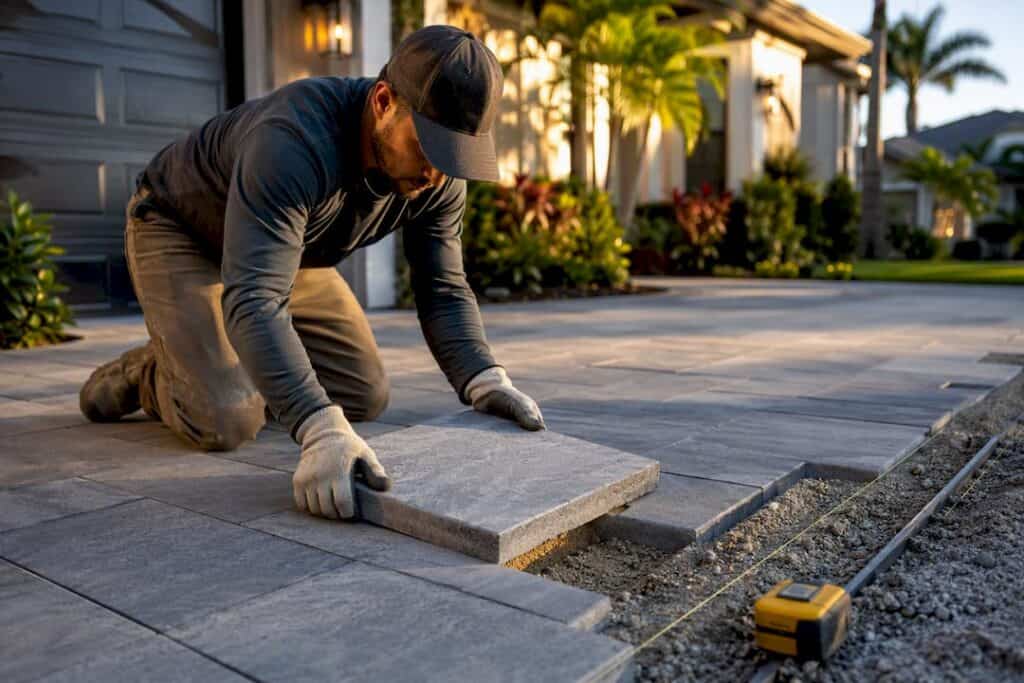
Driveway pavers cost Tampa homeowners roughly $12 to $25 per square foot for a standard installation, with premium materials and patterns pushing $28 to $40. A small 600 sq ft driveway typically runs $7,200 to $15,000, a mid-size 900 sq ft driveway lands between $10,800 and $22,500, and a large 2,000 sq ft driveway falls between $24,000 and $50,000. Most of these projects also require a City of Tampa permit before work begins.
TL;DR:
- A 900-square-foot driveway in Tampa costs between $10,800 and $22,500, depending on material choices, pattern complexity, and site conditions.
- Proper base depth, typically 6 to 12 inches of compacted limerock or crushed stone, is crucial for driveway longevity and can significantly influence the final cost.
- Site factors such as soil drainage, accessibility, grading, and tree protection can cause quote variations of thousands of dollars even for identical driveway sizes.
- Permits are mandatory in Tampa for new or reconfigured driveways, with fees around $145 and potential need for surveys if the area exceeds 1,000 square feet.
- Improving long-term durability involves careful planning of base construction and drainage, making professional installation more cost-effective than DIY for most homeowners.
Table of Contents
- What Does a Driveway Paver Project Actually Cost in Tampa?
- Why Do Two Tampa Homes Get Wildly Different Quotes?
- Do You Need a Permit for a Driveway in Tampa?
- How Do You Get an Accurate, Comparable Quote?
- How Long Does a Paver Driveway Project Take?
- What Does Long-Term Maintenance Cost?
- Why Tampa Homeowners Trust Elite Builder Renovation
- Ready to Get an Honest Quote?
- Sources
- FAQ
What Does a Driveway Paver Project Actually Cost in Tampa?
That per-square-foot range hides a lot of moving parts, and understanding them is how you avoid a surprise change order halfway through the job. Materials alone can shift your price by 40% or more, and labor complexity adds another layer on top of that.
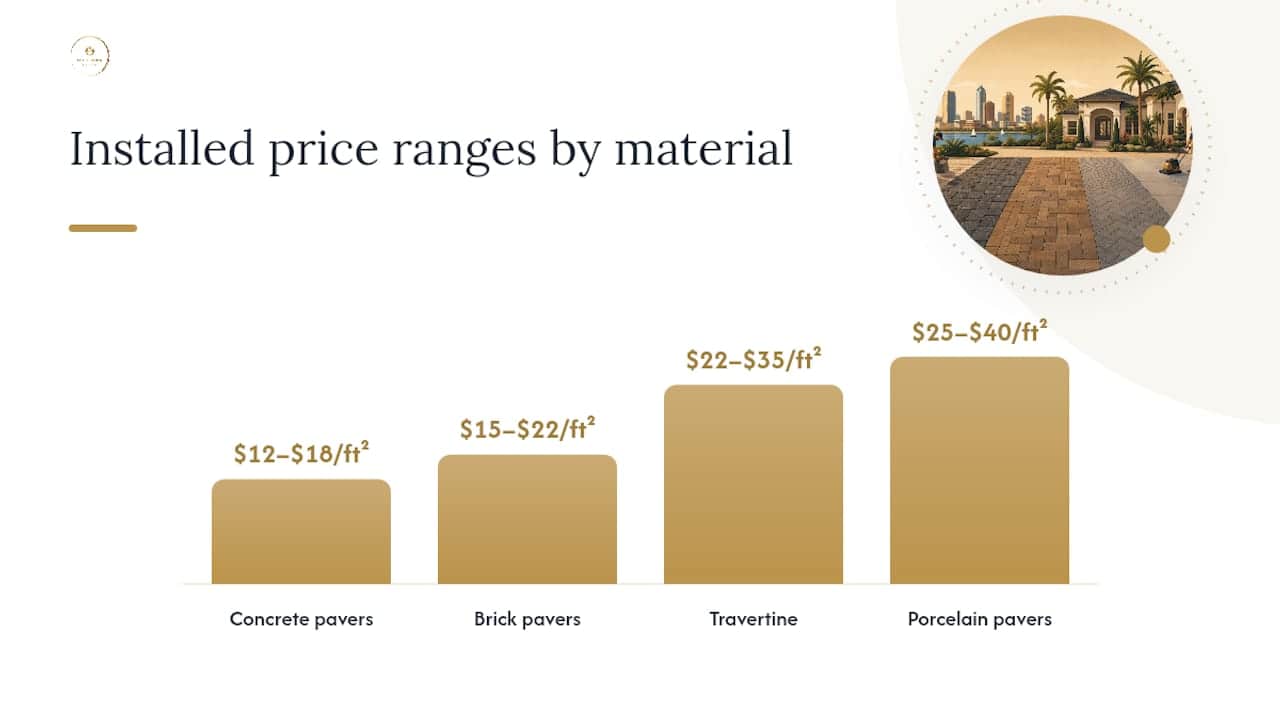
Concrete pavers are the budget-friendly workhorse. Expect $12 to $18 per square foot installed, with premium colors or textures nudging toward $20. Brick pavers run a bit higher, typically $15 to $22 per square foot, prized for their classic look and long track record in older Tampa neighborhoods like Hyde Park and Seminole Heights.
Travertine is where costs climb. This natural stone commonly hits $22 to $35 per square foot because of material cost and the extra care required during cutting and setting. Porcelain pavers are the newest entrant in Florida driveways, running $25 to $40 per square foot, favored for their fade resistance and low water absorption in our humid climate.
Labor and pattern complexity add their own premium. A simple running-bond or herringbone pattern in a single color is the most economical layout. Add a soldier-course border, a circular inlay near the entry, or mixed colors, and labor time climbs, since cutting a curve or fitting a medallion around a driveway edge takes far longer than laying straight rows.
Site preparation is the line item homeowners underestimate most. This includes:
- Demolition and removal of existing concrete, asphalt, or gravel, commonly priced at $2 to $5 per square foot depending on material and disposal fees
- Base excavation and grading to reach proper depth
- Compacted limerock or crushed-stone base, typically 6 to 12 inches deep, which is the single biggest driver of long-term durability
- Edge restraints (plastic or concrete) to keep pavers from spreading under vehicle weight
- Polymeric sand jointing instead of standard sand, which resists Tampa’s heavy summer rain and discourages weed growth
- Optional sealant for stain and fade protection, usually applied after initial cure
Here’s how those numbers play out across common driveway sizes. A Tampa-area cost calculator lists pavers near $17.50 per square foot as a working average, which lines up closely with the ranges below.
Typical cost ranges for small to large driveways cover a broad spectrum, reflecting different material choices and installation complexities.
These figures assume a standard install with a compacted base, edge restraint, and polymeric sand jointing. Add a border pattern, upgrade to travertine, or discover unstable soil under the old driveway, and the total moves toward the high-end fast.
Why Do Two Tampa Homes Get Wildly Different Quotes?
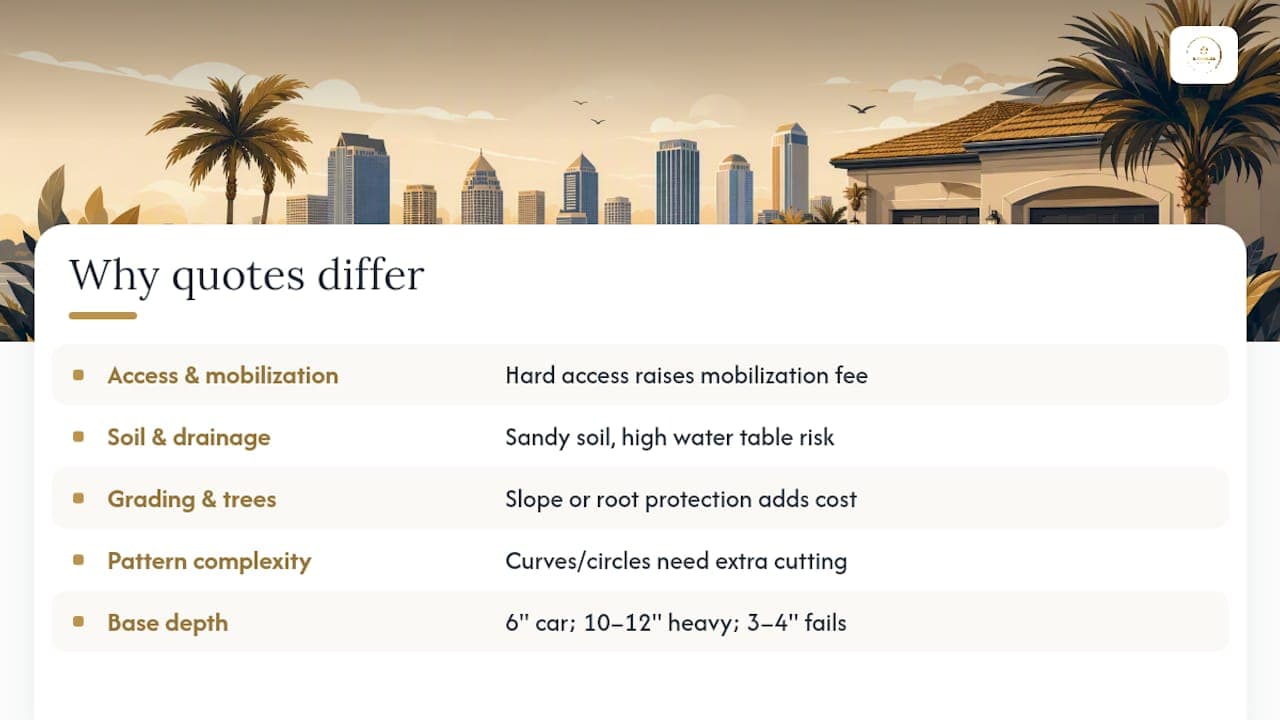
Two neighbors with the same driveway square footage can receive quotes that differ by thousands of dollars, and it usually comes down to five factors that have nothing to do with the paver material itself.
Access and mobilization matter more than most homeowners expect. A crew that has to hand-carry materials around a fence, a pool cage, or a narrow side yard spends hours that a straight, open driveway never requires. Contractors often build a flat mobilization fee into small jobs, which is one reason a tiny 400 sq ft driveway can carry a higher per-square-foot rate than a 1,500 sq ft one.
Soil conditions and drainage are a Tampa-specific wildcard. Much of Hillsborough County and Pinellas County sits on sandy soil with a high water table, especially closer to the bay in areas like St. Petersburg and Clearwater. Poor drainage under a driveway leads to soft spots and settling within a few years, so a competent installer may recommend extra base depth or a French drain along the low side of the slab.
Grading, slope, and tree protection add cost when a lot isn’t flat. Retaining a grade change, protecting root systems near old oaks, or regrading toward a swale all take equipment time that a flat, treeless lot skips entirely.
Pattern complexity and custom cutting show up again here, since curved borders and circular driveways require far more hand-cutting around utility covers and irregular edges.
Pro Tip: Ask every contractor to specify the exact base depth, in inches, on their written quote. A 6-inch compacted limerock base handles a passenger car; a 10 to 12-inch base is what you want under anything heavier, like a boat trailer or a commercial vehicle. This one number tells you more about install quality than the price itself.
Base depth deserves the emphasis. Industry guidance consistently points to a properly compacted base as the leading factor in how long a paver driveway lasts on Florida’s sandy soils, and a shortcut here (3 to 4 inches instead of 6 to 12) is the most common reason driveways settle, shift, or crack within a few years.
Do You Need a Permit for a Driveway in Tampa?
Yes. The City of Tampa requires a permit for new driveways, driveway reconfigurations, and any change of surface material, filed under the Residential Miscellaneous permit category. Typical permit fees run around $145, though the exact amount varies with project scope, according to a Tampa driveway cost breakdown that lists this as a standard budget line.
Your plans need to show:
- Property lines and existing structures
- Site elevations
- Any trees within 20 feet of the work area
- A paver edge-detail drawing, which the city may require specifically for paver installations
Larger driveways trigger an extra step. The city’s residential driveway permit guide requires a topographical survey for driveways at or above 1,000 square feet. That means most medium and large projects in this guide need a licensed surveyor involved before permitting, which adds cost and lead time your contractor should account for in the schedule.
If your driveway crosses a drainage ditch or touches the city’s right-of-way, you’ll need a separate right-of-way permit on top of the standard driveway permit. This applies often in older Tampa neighborhoods where the swale sits between the sidewalk and the street.
A licensed Tampa general contractor who regularly pulls City of Tampa permits will know these thresholds cold and can fold the survey and paperwork into your project timeline instead of surprising you mid-job.
How Do You Get an Accurate, Comparable Quote?
Getting three quotes that actually mean something requires giving every contractor the same information to bid against. Follow this sequence:
- Require the base spec in writing. Every quote should list base material (limerock or crushed stone), base depth in inches, and the compaction method used.
- Ask who handles the permit. Some contractors include permit filing and fees in their price; others expect you to pull it yourself. Get this in writing before comparing totals.
- Confirm insurance and licensing. Ask for a copy of the contractor’s Florida license and general liability certificate, not just a verbal assurance.
- Request references from completed projects, ideally ones within Pinellas County or Hillsborough County where soil and drainage conditions match your own.
- Get the edging and jointing detail spelled out. Plastic edge restraint versus concrete curbing, and standard sand versus polymeric sand, are different price points doing very different jobs.
- Ask about warranty terms, specifically what’s covered if the base settles within the first two years.
Watch for red flags: a quote that skips base depth entirely, a contractor who’s vague about who’s pulling the permit, or one with no verifiable references. These usually signal a low bid that turns into a change order later.
Pro Tip: If you’re already planning other outdoor work, like a paver patio, pool deck extension, or drainage upgrade, ask your contractor to bundle it with the driveway. Combining projects spreads the mobilization cost across more square footage and typically lowers your effective per-square-foot rate.
How Long Does a Paver Driveway Project Take?
Permit review timing varies with the city’s workload, and Tampa’s permitting office tends to see longer queues in spring and early summer when renovation season peaks. Budget several weeks for review before work can legally begin.
Once permitted, installation itself moves through a fairly consistent sequence:
- Demolition and removal of the old surface
- Excavation to design depth
- Base placement and mechanical compaction (often in multiple lifts for deeper bases)
- Bedding sand screeding
- Paver placement in the chosen pattern
- Polymeric sand jointing and final compaction
- Site cleanup and walk-through
A standard driveway typically takes several days to install once the crew is on-site, though larger or more complex jobs run longer. Florida’s summer rain pattern is the wild card. Afternoon storms can halt base compaction or sand jointing, since both need dry conditions to set properly, so ask your contractor how they schedule around wet weather. Most Tampa driveways can handle regular vehicle traffic within a day or two of final compaction.
What Does Long-Term Maintenance Cost?
A well-built paver driveway rewards you with lower lifetime cost than concrete, mainly because repairs are localized instead of requiring a full slab replacement.
Plan for this basic maintenance rhythm:
- Re-sanding with polymeric sand every few years as joints wear from traffic and rain
- Weed control in joints, which polymeric sand largely prevents when applied correctly
- Optional sealant reapplication every 2 to 3 years for stain and color retention
- Spot repairs for any paver that cracks or sinks, which typically costs far less than patching a comparable section of concrete
Most failures trace back to inadequate base depth or poor drainage rather than the pavers themselves. That’s why the base spec you nailed down at quote time pays dividends for decades, not just at installation.
Why Tampa Homeowners Trust Elite Builder Renovation
Elite Builder Renovation has spent over a decade completing more than 375 projects across the Tampa Bay area, and driveway and hardscape work is a regular part of that portfolio alongside kitchen and bathroom remodeling and full home renovations.
Our approach to paver driveways reflects the base-depth and drainage lessons covered above:
- We spec compacted limerock base to the depth your soil and traffic load actually require, not a shortcut minimum
- We handle City of Tampa permitting, site plans, and survey coordination as part of the project, not an afterthought
- We use proper edge restraints and polymeric sand jointing suited to Florida’s rain patterns
- We back every project with a 100% satisfaction guarantee and offer financing options to make the investment manageable
That combination of permit know-how and correct base construction is what separates a driveway that lasts 25 years from one that needs repair in five.
Ready to Get an Honest Quote?
You’ve seen the real numbers now: material costs that swing from $12 to $40 per square foot, a base spec that matters more than the paver brand, and a permit process with a survey trigger most homeowners never see coming. The next step is getting a quote built around your actual lot, not a generic online calculator.
Elite Builder Renovation offers a free consultation for driveway and hardscape projects across Tampa, St. Petersburg, Clearwater, Largo, Safety Harbor, and the surrounding Pinellas County and Hillsborough County area. We walk your site, spec the base depth your soil needs, and handle the City of Tampa permit paperwork so you’re not chasing documents mid-project. Financing options are available to spread the cost of a full driveway replacement or a combined outdoor renovation, and every project carries our 100% satisfaction guarantee.
If you’re weighing a driveway against other renovation priorities, our home remodeling services in Tampa, FL page covers how we bundle exterior and interior projects to stretch your budget further. Request a free consultation today and get a written quote with real base specs, not a vague estimate.
Sources
- Residential Driveways | City of Tampa
- How Much Does a Paver Driveway Cost in Florida | JaxTeller Brick Pavers
- Brick Pavers Installation Price Guide in Tampa, FL | Tampa Paver Service
- Driveway Installation Cost in Tampa: $5,369-$7,265 (2026) | Build-Folio
FAQ
How much does it cost to pave a 2,000 sq ft driveway?
A 2,000 sq ft paver driveway in Tampa typically costs between $24,000 and $50,000, depending on material choice, pattern complexity, and site preparation needs. Standard concrete pavers land near the lower end, while travertine or porcelain with custom patterns push toward the top.
Is it cheaper to pour concrete or install pavers in Florida?
Poured concrete generally costs less upfront than pavers, but pavers cost less to repair over time since a cracked or sunken paver can be pulled and reset without replacing the whole driveway. Concrete typically requires full-section replacement when it cracks, which can erase the initial savings over a driveway’s lifespan.
How much does a paver driveway cost in Florida?
Florida paver driveways commonly run $12 to $25 per square foot for standard installations, with premium materials and complex patterns reaching $28 to $40 per square foot. Tampa-area pricing falls within this same range, with typical projects landing between $15 and $30 per square foot depending on scope.
Do you need a permit for pavers in Florida?
In Tampa, yes: the city requires a permit for new driveways, reconfigurations, or a change of surface material, filed under the Residential Miscellaneous category. Requirements outside Tampa vary by municipality, so check with your local building department if you’re in a different Pinellas County or Hillsborough County city.
What base depth do Tampa driveways need?
Most residential paver driveways need a 6 to 12 inch compacted limerock or crushed-stone base, with deeper bases recommended for heavier vehicles like boat trailers or RVs. This base depth is the leading factor in how long a driveway lasts in Florida’s sandy, high water table soil.
Can I install driveway pavers myself to save money?
DIY installation can cut labor costs but risks the most expensive mistake possible: an undersized or poorly compacted base that causes shifting within a year or two. Most homeowners without heavy equipment access and compaction experience find that professional installation costs less over the driveway’s lifespan once you account for redo work.