
Restaurant renovation cost in Florida typically runs from $165 to $725 or more per square foot, depending on concept and finish level. Kitchen and mechanical, electrical, and plumbing (MEP) systems, especially exhaust hoods, grease interceptors, and electrical upgrades, drive the largest share of that number. A 2,500-square-foot full-service buildout may cost hundreds of thousands to nearly a million dollars including equipment.
TL;DR:
- Kitchen and MEP systems typically make up 30% to 45% of total restaurant renovation costs, with ventilation, plumbing, and electrical upgrades driving major expenses.
- Costs vary significantly by concept, ranging from $165 to $725-plus per square foot, with fine dining at the high end and quick-service at the low end.
- Permitting involves parallel reviews by DBPR and county health departments, requiring detailed plans and built-in time for revisions and plan validity concerns.
- A contingency of 10% to 20% is essential, especially for older buildings with unknown conditions, and phased renovations can help spread capital and reduce risk.
- Local climate factors increase material costs, necessitating corrosion-resistant finishes, hurricane-rated openings, and HVAC equipment suited for humidity to ensure durability.
Table of Contents
- Florida Restaurant Remodel Pricing by Concept
- What Drives Restaurant Remodeling Costs the Most?
- How Florida’s Permitting Process Affects Cost and Schedule
- Smart Budgeting Strategies for a Florida Restaurant Buildout
- Timeline Risks That Drive Up Carrying Costs
- Materials and Design Choices Built for Florida’s Climate
- Sample Restaurant Renovation Budgets by Square Footage
- Why Local Experience Matters for Restaurant Buildouts
- How Elite Builder Renovation Supports Your Restaurant Renovation
- Sources
- FAQ
Florida Restaurant Remodel Pricing by Concept
Not every restaurant renovation carries the same price tag, and lumping a coffee counter in with a white-tablecloth dining room produces a useless estimate. Florida restaurant remodel pricing splits fairly cleanly by concept, and knowing where your project sits on that scale is the fastest way to sanity check a contractor’s quote.
Market data from Orlando puts full buildout costs at $165 to $725-plus per square foot depending on concept and finish quality, and kitchen equipment is frequently priced separately from that range. Tampa-area guidance narrows the low end further: tenant-improvement buildouts in existing restaurant shells often run $165 to $420 per square foot, while ground-up or heavily reconfigured full-service spaces push toward the higher bands.
Rough concept bands you can use for early budgeting:
- Quick-service (QSR): $165 to $300 per square foot, lighter kitchens and simpler finish packages.
- Fast-casual: $200 to $400 per square foot, moderate kitchen complexity and higher-visibility finish work.
- Full-service dining: $300 to $500 per square foot, larger kitchens, bar buildouts, and more extensive MEP.
- Fine dining: $450 to $725-plus per square foot, custom millwork, higher-end finishes, and expanded kitchen capacity.
- Second-generation tenant improvement: $165 to $420 per square foot when existing kitchen infrastructure is reusable.
Most of these ranges cover shell, finishes, and MEP work. Loose kitchen equipment, walk-in coolers, and specialty fixtures often get quoted as a separate line, so always ask whether a quote is “shell and finish” or “turnkey including equipment.”
Applying those bands to real footprints: smaller fast-casual spaces cost less than larger fine-dining projects, with budgets ranging from moderate to multi-million-dollar levels depending on size and concept. Expect Miami to skew toward the top of every band, Orlando to sit in the middle, and Tampa Bay markets, including St. Petersburg and Clearwater, to often price closer to the middle-to-lower range depending on labor availability and site conditions.
What Drives Restaurant Remodeling Costs the Most?
Kitchen infrastructure and MEP systems typically make up 30% to 45% of total buildout cost, making it the single largest slice of any restaurant renovation budget in Florida. Everything else, floors, paint, seating, matters, but it rarely moves the total the way a hood system or a grease interceptor can.
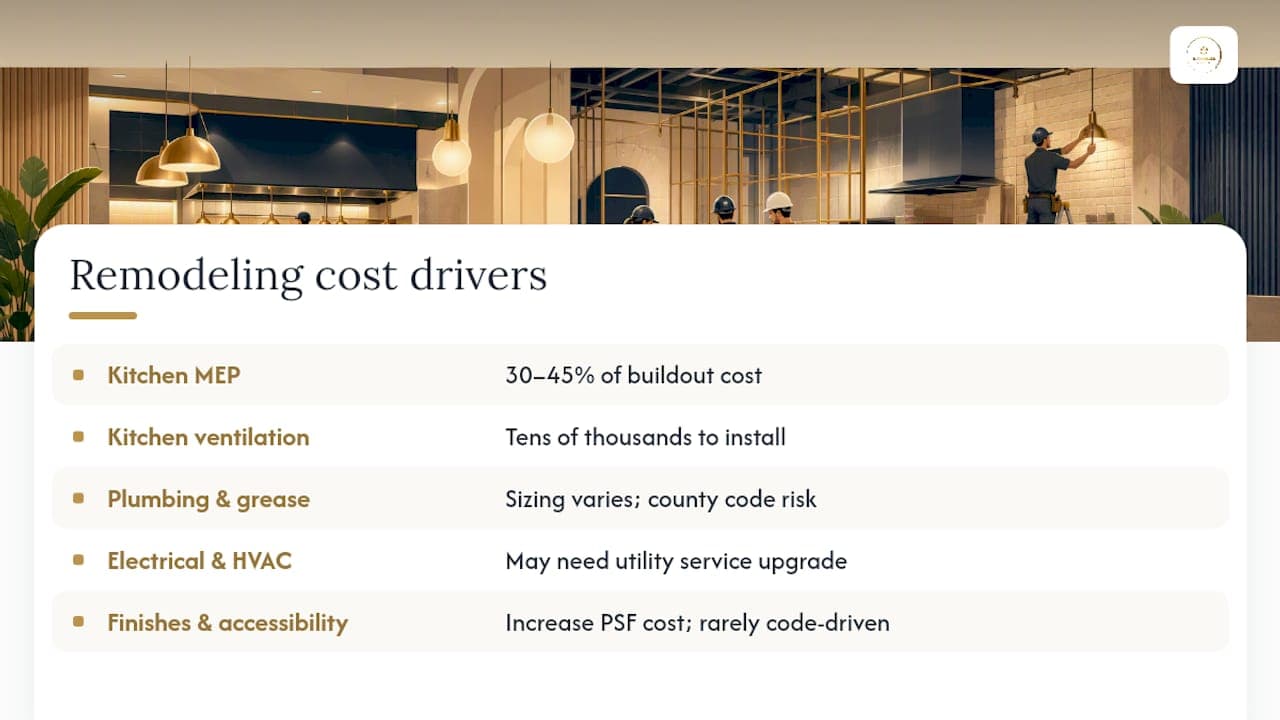
Kitchen and ventilation. A Type I hood system for cooking equipment that produces grease-laden vapors requires a matched exhaust fan, ductwork, and fire suppression, and in many cases a dedicated make-up air unit to replace the volume of conditioned air the hood pulls out. This assembly alone can run into the tens of thousands of dollars before installation labor.
Plumbing and grease management. Grease trap or grease interceptor sizing depends on seating count, menu type, and expected wastewater flow, and requirements vary by county. Relocating floor drains, adding hand sinks, or rerouting sanitary lines to meet code adds both cost and schedule risk, particularly in older buildings with undersized existing plumbing.
Electrical and HVAC. Commercial kitchen equipment often demands a service upgrade from the utility, new panels, and dedicated circuits. HVAC sizing has to account for kitchen heat load, not just dining-room comfort, which is a common miss in early budgets.
Finishes and accessibility. Flooring, wall systems, and restroom accessibility upgrades affect PSF cost but rarely cause code-driven scope surprises the way kitchen and MEP work does.
Pro Tip: Get your mechanical contractor to walk the space before you finalize a menu. Hood and make-up air sizing is driven by cooking equipment BTU output, and a late menu change can force an expensive redesign of ventilation you already installed.
How Florida’s Permitting Process Affects Cost and Schedule
Florida restaurants clear two separate approval tracks before they can open, and treating them as one process is a common budgeting mistake. The Florida Department of Business and Professional Regulation (DBPR) requires plan review and approval for new construction or remodels that affect sanitation or safety, and reopening after an extended closure can trigger the same review. Separately, your county health department reviews a detailed plan package before issuing local approval.
- Prepare your submission package. County plan-review worksheets require scaled floor plans, a proposed menu, equipment specifications, finish schedules, and plumbing and ventilation details for new and remodeled food establishments.
- Submit to DBPR and your local building department in parallel. Running both reviews at the same time, rather than sequentially, shortens total approval time and reduces the risk that one agency’s revision request forces rework already approved by the other.
- Budget time for revision cycles. Plans rarely clear on the first pass. Build at least one round of comments and resubmission into your schedule.
- Track plan validity. Approved DBPR plans are typically valid for a limited period, often around 18 months, so delays on the construction side can force you to resubmit.
If you’re unfamiliar with how local building departments handle commercial submissions, our guide to the commercial building permit process walks through what county reviewers actually check before issuing approval.
Smart Budgeting Strategies for a Florida Restaurant Buildout
A restaurant renovation budget in Florida needs more than a single number. It needs a structure that absorbs surprises without derailing your opening date.
- Size your contingency to the building’s condition. A newer second-generation restaurant space might only need a 10% buffer, but an older building with unknown plumbing or electrical conditions deserves closer to 20%.
- Negotiate your tenant improvement (TI) allowance before you sign. Landlords sometimes offer a per-square-foot TI credit toward buildout costs; get it in writing and confirm whether it’s paid upfront or reimbursed after milestones.
- Match financing to project phase. Contractor-arranged financing or short-term loans can bridge the gap between TI disbursement and invoice due dates, while owner equity is often reserved for equipment purchases that a lender won’t touch.
- Consider phased renovation. Opening with a leaner buildout and adding a bar expansion or patio later spreads capital outlay and lets early revenue help fund phase two.
- Value-engineer with durability in mind. Swapping a premium tile for a mid-grade option can save money upfront, but choosing a finish that fails a health inspection or wears out in two years usually costs more over the life of the space than the initial savings.
Pro Tip: Ask your landlord whether the TI allowance is tied to specific milestones like rough-in inspection or certificate of occupancy. Allowances tied to vague “completion” language have led to payment disputes on more than one Tampa Bay project.
Timeline Risks That Drive Up Carrying Costs
Restaurant remodel timelines vary by scope, with light remodels often lasting a few months and full buildouts taking several months or longer, especially for high-end projects.
Every week of delay costs money whether or not the doors are open, so use our Construction Company Financial Waste Checklist to identify and avoid budget leak risks during your renovation project. Common delay triggers include:
- Plan revisions requested by DBPR or the county health department.
- Failed inspections on rough electrical, plumbing, or hood installation.
- Equipment lead times, especially for custom hoods or imported fixtures.
- Skilled-trade shortages that slow scheduling for electricians and mechanical contractors.
If your lease runs $8,000 a month and you’re carrying two managers on payroll during buildout, a single month of delay can cost $12,000 to $18,000 in rent and payroll alone, before lost opening revenue.
Materials and Design Choices Built for Florida’s Climate
Florida’s humidity, salt air, and hurricane exposure change what “durable” means compared to inland markets. Local contractors report that hurricane-code requirements and coastal conditions raise material and labor costs compared with many other regions, so material selection deserves real attention up front.
- Choose smooth, nonabsorbent, easily cleanable finishes, quarry tile, fiberglass-reinforced plastic (FRP) wall panels, stainless steel, and coved wall-to-floor junctures, since Florida health inspectors specifically check for these in food prep areas.
- Specify corrosion-resistant storefront glazing and hurricane-rated exterior openings, especially for coastal locations in Pinellas County.
- Select HVAC equipment rated for continuous high-humidity operation, and protect exposed kitchen equipment from salt-air corrosion with proper coatings and ventilation.
Sample Restaurant Renovation Budgets by Square Footage
The table below uses full-service assumptions at a mid-range PSF and includes kitchen equipment. QSR or fast-casual projects will slide toward the lower end of the concept bands discussed earlier, and equipment-excluded shell quotes will run lower than these totals.
| Line Item | 1,000 SF | 2,500 SF | 5,000 SF |
|---|---|---|---|
| Shell/TI and finishes | $130,000 | $325,000 | $650,000 |
| Kitchen buildout and MEP | $110,000 | $275,000 | $550,000 |
| Kitchen equipment | $60,000 | $150,000 | $300,000 |
| Permits and fees | $8,000 | $18,000 | $32,000 |
| Professional fees (design/engineering) | $20,000 | $45,000 | $85,000 |
| Contingency (15%) | $49,200 | $122,000 | $244,000 |
| Estimated total | $377,200 | $935,000 | $1,861,000 |
Adjust these figures up for fine dining or coastal storefront work, and down for QSR concepts or second-generation spaces with reusable hoods, grease interceptors, and electrical service. For a deeper breakdown of kitchen-specific costs within these totals, see our kitchen renovation cost guide for Florida.
Why Local Experience Matters for Restaurant Buildouts
Elite Builder Renovation has completed more than 375 projects across the Tampa Bay area, and restaurant owners benefit from the same disciplined approach. A proper preconstruction package includes an MEP condition report, a permit checklist mapped to DBPR and local requirements, and a phased cost estimate tied to construction milestones.
That level of upfront evaluation catches issues, like an undersized grease interceptor or an electrical panel that can’t support new kitchen equipment, before they become change orders. Lenders and landlords also respond well to a contractor who can show a clear, phased plan rather than a single lump-sum guess.
How Elite Builder Renovation Supports Your Restaurant Renovation
Elite Builder Renovation gives Florida restaurant owners a single point of accountability instead of juggling separate designers, permit runners, and subcontractors on your own. Our team handles preconstruction MEP evaluation, coordinates DBPR and local plan review, and manages the buildout from demolition through final inspection, all under one contract with one schedule.
Every project starts with a free consultation, and financing options are available for owners who need to phase capital outlay around a TI allowance or opening-season cash flow.

If your renovation touches the kitchen, and most restaurant projects do, start with our Tampa Bay kitchen remodel team to scope equipment layout and MEP needs before you finalize your budget. Owners taking on a full-scope renovation in Hillsborough County can also review our Tampa home and commercial remodeling services for a sense of how we structure larger projects. Ready to see where your project lands? Request a free consultation and get a phased estimate before you sign a lease or a contractor agreement.
Sources
- Food Establishment plan review worksheet — Florida Department of Health
- Hotels and Restaurants – Plan Review — Florida DBPR
- Restaurant Buildout Cost in Orlando, FL: 2026 Complete Guide — TM International Group
- Tampa restaurant construction cost estimator — Terrapin Construction Group
FAQ
What Is the 30% Rule for Renovations?
The 30% rule is a rough guideline suggesting kitchen and MEP work, hoods, plumbing, and electrical, should account for roughly 30% to 45% of your total restaurant renovation budget, which lines up with industry cost breakdowns showing kitchen infrastructure as the largest single cost category.
How Much Does It Cost to Remodel a Restaurant in Florida?
Florida restaurant remodels typically run $165 to $725-plus per square foot depending on concept, with second-generation tenant improvements often falling in the $165 to $420 per square foot range in the Tampa Bay area.
How Much Does It Cost to Build a 5,000 Square Foot Restaurant?
A 2,500-square-foot full-service buildout in Florida may cost hundreds of thousands to nearly a million dollars including kitchen equipment, depending on concept, finish level, and whether the space is new construction or a renovated shell.
Does Gordon Ramsay Pay for Restaurant Renovations?
On his television program, the featured restaurant’s renovation is typically funded by the show’s production budget rather than the owner, which is different from a standard commercial renovation where the operator or landlord covers buildout costs directly.
Should I Hire a Contractor Before Finalizing My Restaurant Design?
Yes. Bringing in a contractor during preconstruction, before finishes and equipment are locked in, lets you get an MEP condition report and phased cost estimate that catches expensive surprises like undersized electrical service or grease interceptor upgrades early, which is the core value Elite Builder Renovation provides on Tampa Bay restaurant projects.