

Most Tampa homeowners should plan to spend a mid-range amount for a full roof replacement on a typical 1,500–2,500 sq ft home, with Angi’s Tampa-area reporting placing the city average near $13,391. Costadia’s 2026 localized data shows asphalt shingle jobs typically running in a moderate price range. Those figures include materials, labor, standard tear-off, disposal, and a Hillsborough County permit. Here’s a quick material snapshot:
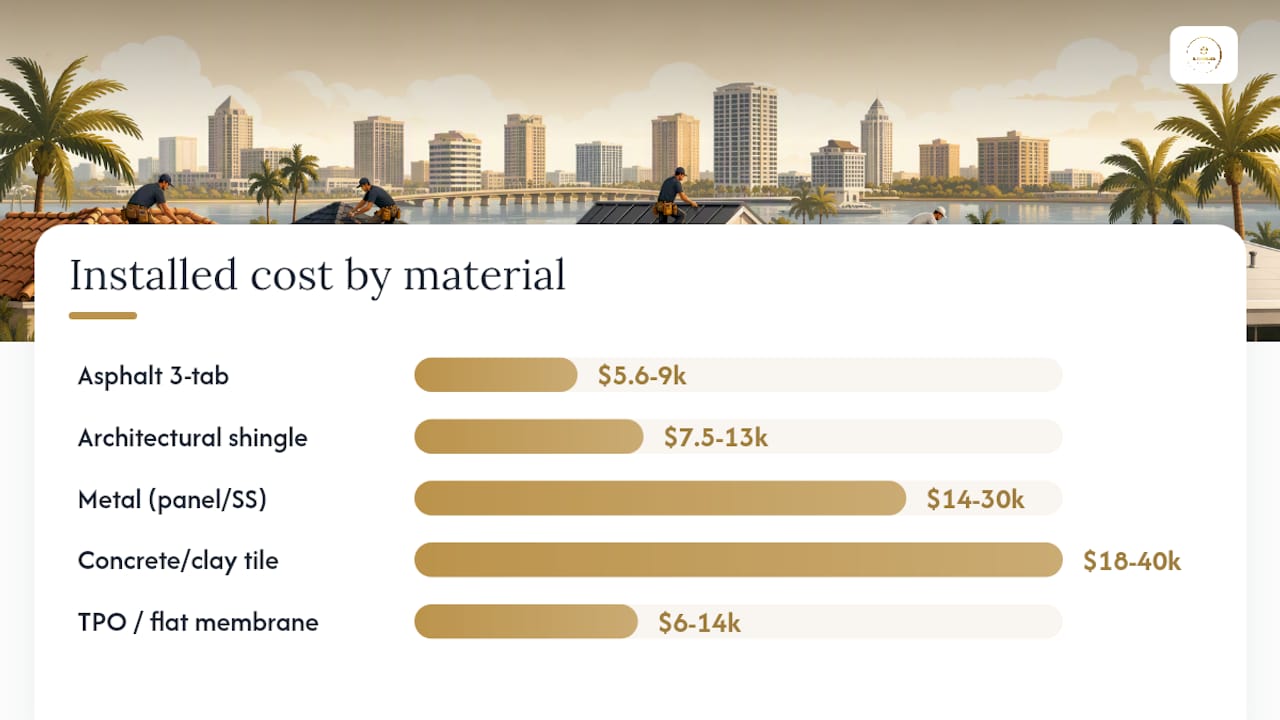
- Asphalt architectural shingles: moderate price range installed
- Metal roofing (standing seam or panels): $14,000–$30,000+
- Concrete or clay tile: $18,000–$40,000+
- TPO/flat systems: $6,000–$14,000
Permit and disposal fees are included in the ranges above unless noted otherwise. For a precise figure tied to your home’s size, pitch, and zip code, request a free roof replacement estimate from Elite Builder Renovation.
Key Takeaways
Most Tampa homeowners should budget $8,500–$16,000 for a full roof replacement, with material choice, roof pitch, and HVHZ code requirements being the three variables most likely to move the final number.
| Point | Details |
|---|---|
| Tampa cost range | Most homes fall between $8,500–$16,000; the city average is near $13,391. |
| Biggest cost driver | Material choice: switching from asphalt to metal or tile can double or triple the installed price. |
| Florida 25% rule | Repairs covering more than 25% of the roof in 12 months legally require a full code-compliant replacement. |
| Best scheduling window | October through April (dry season) offers better contractor availability and avoids post-storm demand surges. |
| Elite Builder Renovation | Provides written, itemized quotes, pulls permits, and handles HVHZ compliance across Tampa Bay. |
Table of Contents
- What does roof replacement cost in Tampa typically look like?
- What factors push your Tampa roof quote up or down?
- How does roofing material affect your Tampa installation price?
- Quick reference: estimated cost by roof size in Tampa
- What you need to know about Tampa permits and Florida’s 25% rule
- How long does a Tampa roof replacement take, and when should you schedule it?
- Insurance, wind mitigation, and warranty considerations
- How to get accurate Tampa quotes and what red flags to watch for
- How these Tampa numbers were calculated
- Why Tampa homeowners choose Elite Builder Renovation for roofing
- Sources
- FAQ
What does roof replacement cost in Tampa typically look like?
Tampa sits slightly below Miami and Naples on Florida’s city price ladder, but local labor rates, Hillsborough County permit fees, and High-Velocity Hurricane Zone (HVHZ) code requirements keep costs meaningfully above national averages in many neighborhoods. BuildFolio’s Tampa calculator puts a 2,200 sq ft all-material installed job at $12,302–$16,643, using a local labor rate of $58/hr and a Hillsborough County permit estimate near $195.
The table below shows typical installed cost ranges for the most common roofing materials on a 2,000 sq ft Tampa home. All figures include labor, tear-off, standard underlayment, disposal, and permit.
What’s typically included:
- Roofing materials and underlayment
- Labor and crew staging
- Standard tear-off of one existing layer
- Debris hauling and disposal
- Hillsborough or Pinellas County permit (see footnote)
What homeowners often pay extra for:
- Decking replacement (rotted or damaged sheathing)
- Structural repairs to rafters or trusses
- Skylight removal, flashing upgrades, or chimney work
- Second-layer tear-off when two layers already exist
- HVHZ-rated product upgrades in coastal or high-wind zones
Permit footnote: Hillsborough County and Pinellas County permit fees typically vary based on project valuation. Your licensed contractor pulls the permit and includes the fee in the contract price.
What factors push your Tampa roof quote up or down?
Understanding the cost drivers before you call a contractor puts you in a much stronger negotiating position. Here are the main variables, roughly in order of impact:
- Roof size (squares): Roofing is priced per “square” (100 sq ft). A 20-square roof costs proportionally less per square than a 30-square roof due to mobilization and staging efficiencies.
- Material choice: The single biggest lever. Switching from 3-tab asphalt to standing-seam metal can triple the installed cost on the same house.
- Roof pitch and complexity: A steep 8:12 or 10:12 pitch requires safety equipment and slower installation. Expect a 15–25% labor premium over a standard 4:12 pitch. Multiple valleys, dormers, and hip-and-ridge lines add similar complexity costs.
- HVHZ and code requirements: Homes in High-Velocity Hurricane Zone areas face stricter product approval and installation standards, which raises both material and labor costs.
- Tear-off layers: Removing two existing layers instead of one adds roughly $500–$1,500 to the job.
- Decking repairs: Rotted or soft sheathing discovered during tear-off is billed separately, often at $75–$150 per sheet of plywood replaced.
- Roof access and staging: Low-clearance lots, pool cages, or second-story additions that limit equipment access increase labor time and cost.
Two quick examples: a standard 2,000 sq ft home with a 4:12 pitch and one tear-off layer might quote at $10,500 in architectural shingles. Add a steep 8:12 pitch and three sheets of decking replacement, and that same job can reach $13,000–$14,000. A hip roof with multiple valleys on the same footprint adds another $800–$1,500 in labor.
Pro Tip: Ask your contractor to separate decking repair costs as a line item with a per-sheet rate before work begins. That way, if the crew finds more damage than expected, you know exactly what each additional sheet costs rather than facing a surprise lump-sum change order.
How does roofing material affect your Tampa installation price?
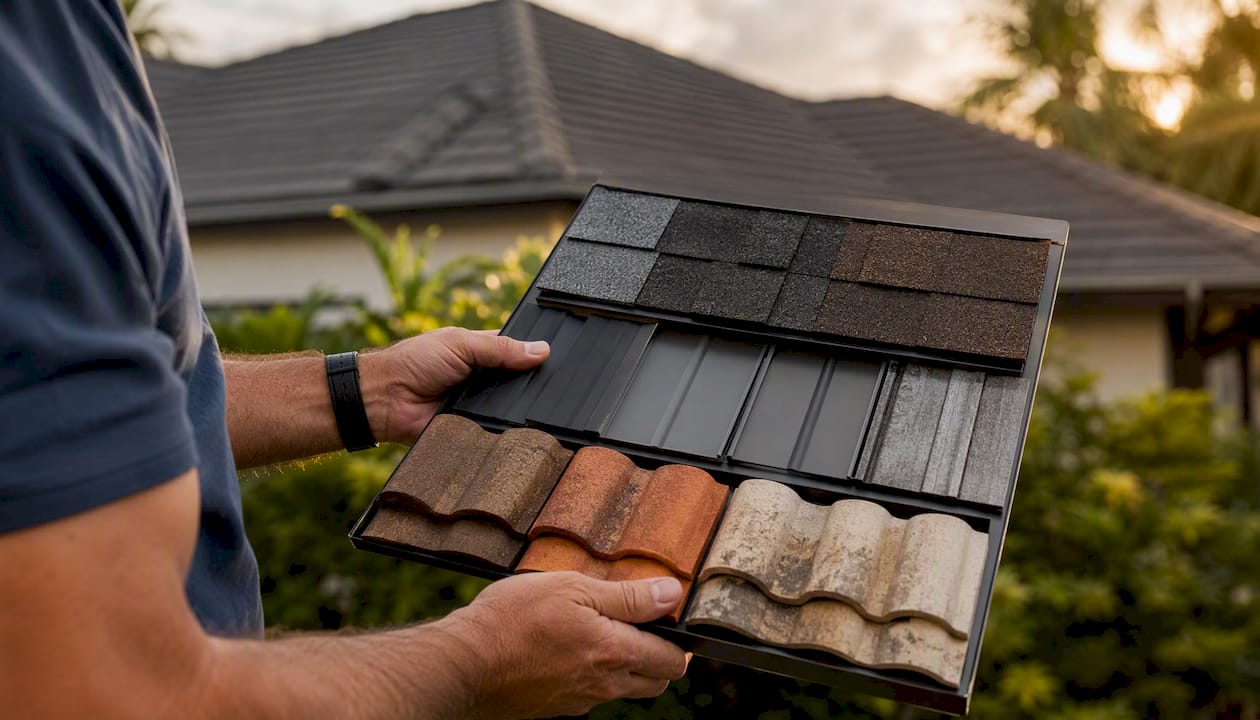
Material choice drives more of the final price than almost any other single decision. Here’s how each major option stacks up for Tampa’s climate, which combines intense UV exposure, high humidity, salt-air corrosion in coastal neighborhoods, and hurricane-force wind events.
| Material | Tampa installed range | Expected lifespan | Wind resistance |
|---|---|---|---|
| Asphalt 3-tab | $5,600–$9,000 | 15–20 years | Moderate (typical wind rating) |
| Architectural shingles | $7,500–$13,000 | 25–30 years | Good (typical wind rating) |
| Metal (panels/standing seam) | $14,000–$30,000 | 40 years | Excellent (typical high wind rating) |
| Concrete or clay tile | $18,000–$40,000 | 40 years | Very good (with proper fastening) |
| TPO / flat membrane | $6,000–$14,000 | 15–25 years | Good (low-slope applications) |
Asphalt shingles remain the most common choice in Tampa and Hillsborough County. Architectural (dimensional) shingles outperform 3-tab in wind uplift and carry longer manufacturer warranties, making them the better value for most homeowners. Costadia’s Tampa data confirms the typical installed outcome near $8,550 for this material.
Metal roofing carries a higher upfront cost but delivers a compelling lifecycle argument in Tampa. Reflective metal panels can reduce attic temperatures and lower cooling loads, a benefit the U.S. Department of Energy’s cool-roof guidance supports for hot climates. Some insurers in Florida also offer wind-mitigation credits for metal roofs, which can offset premium costs over time.
Concrete and clay tile are common in Pinellas County and coastal communities. They handle heat and salt air well, but the added structural weight requires a verified roof deck and framing capacity. Budget for a structural assessment if your home wasn’t originally built for tile.
TPO and flat systems apply to low-slope or flat-roof sections, common on additions, garages, and some mid-century Tampa homes. Reflective TPO membranes also qualify as cool-roof products under DOE guidance.
Quick reference: estimated cost by roof size in Tampa
The table below uses architectural asphalt shingles as the baseline material and assumes a standard 4:12 pitch, one tear-off layer, and permit included. Adjust upward for steeper pitches, premium materials, or decking repairs.
| Roof size (sq ft) | Squares | Tampa estimated range |
|---|---|---|
| 1,000 | 10 squares | $4,200–$6,500 |
| 1,500 sq ft | 15 squares | $6,000–$9,500 |
| 2,000 sq ft | 20 squares | $7,500–$13,000 |
| 2,500 sq ft | 25 squares | $9,500–$16,000 |
| 3,000 | 30 squares | $11,500–$19,500 |
| 3,500+ | 35 squares | $13,500–$23,000+ |
Assumptions: architectural asphalt shingles, standard 4:12 pitch, single tear-off layer, Hillsborough County permit included. Larger or more complex roofs trend toward the upper end of each range.
What you need to know about Tampa permits and Florida’s 25% rule
Pulling a permit is not optional for roof replacement in Tampa or anywhere in Hillsborough and Pinellas counties. A licensed contractor handles the permit application, and the fee is included in a properly written contract. What many homeowners don’t realize is that Florida building code also limits how much of a roof can be repaired or recovered without triggering a full replacement.
Florida Building Code limits repairs or recoveries to no more than a quarter of the total roof area in any 12-month period unless the entire roofing system or section is replaced to meet current code requirements. This rule prevents incremental patching that would otherwise allow aging roofs to avoid modern wind and water-resistance standards.
The practical implication: if you’ve had repairs done in the past year covering more than a quarter of your roof area, your next project may legally require a full replacement rather than another patch. That’s worth knowing before you budget for a “partial repair.” Review the Florida Building Code Chapter 15 language directly if you’re unsure where your property stands.
HVHZ considerations for Tampa-area homeowners:
- Homes in High-Velocity Hurricane Zone jurisdictions must use roofing assemblies that carry specific product approvals and pass test standards such as FM 4470/4471, TAS 114, and TAS 301.
- Up confirm that these standards raise both material specifications and installation labor requirements.
- Impact-rated shingles, enhanced fastening patterns, and secondary water barriers are common HVHZ add-ons that increase cost but also improve wind-damage resistance and may qualify the home for insurance discounts.
- Ask your contractor to confirm whether your specific address falls under HVHZ rules before signing a contract.
For a broader look at what Florida permits cover across renovation projects, the Elite Builder Renovation permits guide walks through the process clearly.
How long does a Tampa roof replacement take, and when should you schedule it?
Typical project timeline
- Permit application and approval: 3–7 business days in Hillsborough County; Pinellas County timelines are similar.
- Material delivery and staging: 1–2 days before the crew arrives.
- Tear-off of existing roofing: Half a day to one full day for a standard 20-square home.
- Decking inspection and repairs: Same day as tear-off if damage is minor; an extra day if significant sheathing replacement is needed.
- Underlayment, flashing, and new roofing installation: 1–3 days depending on material and crew size.
- Final inspection and cleanup: 1–2 days after installation; the county inspector schedules the visit.
Most standard asphalt shingle replacements in Tampa complete in 2–4 days of active work, with total project time (permit to final inspection) running 1–3 weeks.
Seasonal timing in Tampa
Tampa’s wet season runs roughly June through September, with afternoon thunderstorms that can delay open-roof work and increase the risk of interior water exposure during tear-off. Hurricane season overlaps that window (June 1 through November 30), adding contractor demand spikes after storm events.
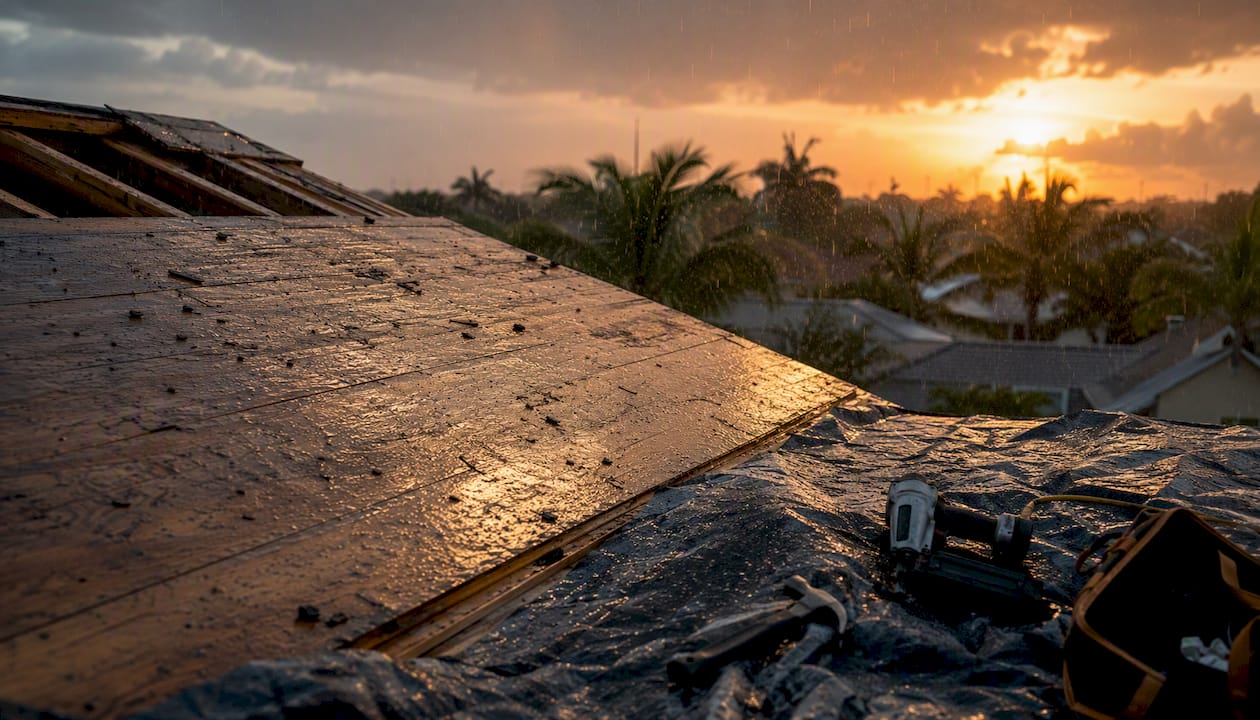
The dry season (October through May) is the preferred scheduling window. Contractor availability is generally better in October–November and again in February–April before the spring rush. Scheduling during peak post-storm demand periods (typically October–December after an active hurricane season) can push prices up and extend lead times by several weeks.
Pro Tip: Book your estimate and sign your contract in January or February if your roof is approaching end of life. You’ll secure a spot before the spring rush, avoid competing with post-storm demand, and give yourself time to compare at least three written quotes without pressure.
Insurance, wind mitigation, and warranty considerations
When insurance covers roof replacement
A homeowner’s insurance policy typically covers roof replacement when the damage results from a sudden, covered peril — most commonly wind, hail, or falling debris. Wear and age-related deterioration is generally excluded. After a storm event, document damage with photos before any temporary repairs, then contact your insurer to open a claim before signing any contractor agreement.
Assignment of Benefits (AOB) caution: Florida has seen significant issues with contractors soliciting homeowners to sign AOB agreements that transfer insurance claim rights to the contractor. This can complicate your claim and limit your control over the settlement. Work directly with your insurer and hire a contractor independently.
Wind mitigation inspections
A wind mitigation inspection (performed by a licensed inspector, not the roofing contractor) documents your roof’s construction features: shape, deck attachment, opening protection, and roof covering type. Insurers use this report to calculate wind-mitigation credits, which can reduce annual premiums by hundreds of dollars. If you’re replacing your roof with a wind-rated or metal system, schedule a wind mitigation inspection after completion.
Warranties to verify in every quote
- Manufacturer material warranty: Covers defects in the roofing product itself. Architectural shingles typically carry 30-year to lifetime limited warranties; metal systems often carry 40-year or longer coverage.
- Workmanship warranty: Covers installation errors. Reputable Tampa contractors offer 2–10 years; ask for the specific term and what it excludes.
- Statutory requirements: Florida law sets minimum contractor liability standards; verify your contractor carries active general liability and workers’ compensation coverage.
- Transferability: If you sell the home, can the warranty transfer to the new owner? Some manufacturer warranties allow one transfer; others do not.
Consumer Reports’ roofing buying guide recommends verifying both material and workmanship warranty terms before signing, and confirms that installation quality affects whether manufacturer warranties remain valid.
How to get accurate Tampa quotes and what red flags to watch for
A trustworthy Tampa roofing estimate is a written document, not a verbal ballpark. It should itemize materials by brand and product line, labor, underlayment type, tear-off, disposal, permit fee, and warranty terms. Lump-sum bids make it impossible to compare contractors fairly.
12 questions to ask every contractor
- Are you licensed in Florida and insured with active general liability and workers’ comp?
- Will you pull the permit, and is the fee included in this quote?
- Can you provide three local references from Tampa or the surrounding area completed in the past 12 months?
- What specific shingle brand, product line, and wind-speed rating are you quoting?
- What underlayment product and thickness are you using?
- How do you handle decking damage found during tear-off — and what is the per-sheet cost?
- What is your workmanship warranty term, and what does it exclude?
- Is the manufacturer warranty a standard or enhanced (contractor-tier) coverage?
- What is the payment schedule, and do you require more than 10–15% upfront?
- Who is the crew — your own employees or a subcontractor?
- How do you handle HVHZ product approval requirements if they apply to my address?
- What is the realistic start date and total project duration?
Red flags to watch for
- No permit offered or contractor suggests skipping it to “save money”
- Cash-only payment required upfront in full
- Unusually low bid with no line-item breakdown
- High-pressure tactics to sign same-day, especially after a storm
- No physical business address or verifiable Florida license number
- Reluctance to provide written references or proof of insurance
If a contractor checks any of these boxes, walk away. A licensed Tampa general contractor will always provide a written, itemized estimate and handle permitting as a standard part of the job.
How these Tampa numbers were calculated
Transparency matters when you’re making a $10,000–$30,000 decision. Here’s how the figures in this article were localized to Tampa:
- National baseline: Contractor pricing aggregates (Angi, Costadia, BuildFolio) provided national and Florida-level installed-cost ranges as starting points.
- Tampa/St. Pete metro labor index: The Bureau of Labor Statistics Construction and Extraction occupational wage data for the Tampa-St. Petersburg-Clearwater metro area was used to apply a local labor adjustment. Tampa labor rates run slightly below the Florida state average, reflected in the figures here.
- Hot-climate factor: A modest upward adjustment accounts for Tampa’s heat and humidity, which affect underlayment and flashing specifications and slow installation pacing during summer months.
- Permit fees: Hillsborough County permit fees of $195–$275 and Pinellas County comparable fees were incorporated into the installed-cost totals.
- Cross-check: Multiple local calculators were compared. BuildFolio’s Tampa estimate ($12,302–$16,643 for 2,200 sq ft) and Costadia’s asphalt baseline ($5,600–$11,500) bracket the mid-range figures used throughout this article. Angi’s Tampa average of $13,391 serves as a corroborating midpoint.
A note on precision: No online calculator replaces an on-site estimate. Roof pitch, decking condition, HVHZ applicability, and material availability all shift the final number. Use the ranges here to set a realistic budget, then get at least two written quotes from licensed Tampa contractors to confirm your specific cost.
For a similarly transparent cost breakdown on other home projects, the kitchen remodel cost guide on this site follows the same localization methodology.
Why Tampa homeowners choose Elite Builder Renovation for roofing
Elite Builder Renovation has completed over 375 projects across the Tampa Bay area, including Hillsborough County, Pinellas County, St. Petersburg, Clearwater, and Safety Harbor. The team handles every stage of a roofing project: permit application, tear-off, decking assessment, installation to Florida code, final inspection, and cleanup. HVHZ product approval requirements are managed in-house, so homeowners don’t have to navigate those specifications alone.
If a roof inspection reveals interior water damage or mold, the water damage restoration team in Tampa handles remediation as part of the same project, eliminating the coordination burden of managing two separate contractors.
Financing options are available for qualified homeowners through Elite Builder Renovation’s home improvement financing program, making it possible to address a failing roof without depleting savings.
Schedule a free roof inspection and estimate to get a written, line-item quote specific to your home’s size, pitch, and material preferences.
Sources
- 1512.1 Scope. Sections 1512 through 1525 set forth minimum requirements for the installation of roofing components…
- Up
- Tampa, FL Asphalt Shingle Roof Replacement Cost (2026): $5,600–$11,500
- Roof Replacement Cost in Tampa: $12,302-$16,643 (2026)
- How Much Does Roof Replacement Cost in Tampa, FL?
FAQ
How much does it cost to roof a 1,500 sq ft house in Tampa?
A 1,500 sq ft home in Tampa typically runs $6,000–$9,500 installed with architectural asphalt shingles, assuming a standard pitch, one tear-off layer, and permit included. Steeper pitches or premium materials push the cost higher.
What is the 25% roof rule in Florida?
If that threshold is exceeded, the entire roofing system or section must be replaced to meet current code standards.
What time of year is cheapest to replace a roof in Tampa?
Scheduling in the dry season, roughly October through April, generally offers better contractor availability and avoids the demand surges that follow hurricane-season storm events. January through February is often the most favorable booking window.
How much does it cost to replace a roof on a 4,000 sq ft house in Tampa?
A home larger than 3,500 sq ft falls above the ranges in the standard size table; expect installed costs to increase substantially for architectural asphalt shingles, depending on pitch complexity, material upgrades, and decking condition. Metal or tile roofing on a home that size can exceed $40,000.