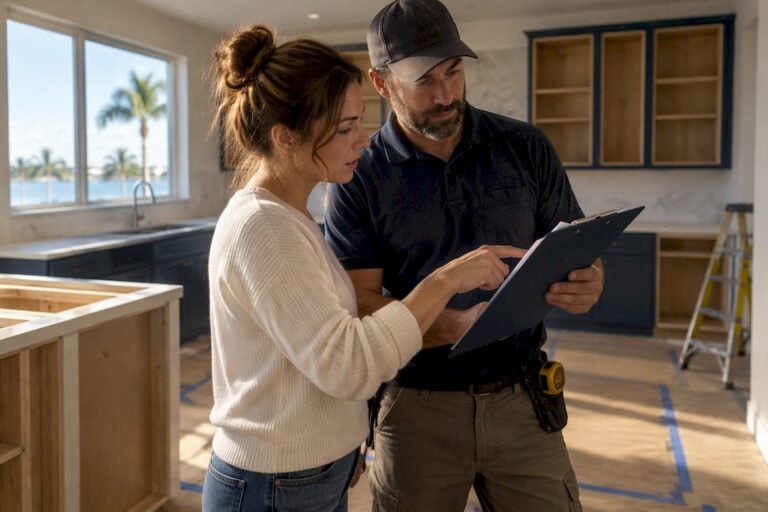


An interior renovation updates your home’s finishes, fixtures, and minor layout elements without changing the structural footprint — and the single most useful thing you can do right now is define your scope before you set a budget.
Before you call a contractor or price out tile, take these four steps:
- Write a one-paragraph problem statement. What is broken, outdated, or not working in your home? Be specific: “The master bath has cracked tile, a leaking valve, and no ventilation fan.”
- List rooms in scope and rooms out of scope. Scope creep is the leading cause of budget overruns. Decide now what is included.
- Sort must-haves from nice-to-haves. Must-haves protect health, safety, and function. Nice-to-haves are upgrades you can defer if costs rise.
- Confirm local permit triggers. In Tampa, St. Petersburg, Clearwater, and across Pinellas and Hillsborough counties, certain work requires permits before you start. A quick call to your local building department takes 10 minutes and can save you thousands.
Elite Builder Renovation offers free consultations for homeowners across the Tampa Bay area. Scheduling one early — before you finalize scope — is the fastest way to get a written estimate tied to real milestones, not guesswork.
Table of Contents
- What is the difference between renovation and remodeling?
- How do you set clear goals and build a workable budget?
- How do you find and hire the right contractor or designer?
- What requires a permit, and how do you check?
- What does a typical renovation timeline look like?
- When should you hire specialists versus doing it yourself?
- How do you choose materials and finishes that will last?
- What does a $10,000 bathroom remodel actually include?
- How Elite Builder Renovation plans and delivers your project
- Key Takeaways
- Your next step with Elite Builder Renovation
- Useful sources and links
- FAQ
What is the difference between renovation and remodeling?
Homeowners and contractors often use these terms interchangeably, but they describe fundamentally different scopes of work. Getting the definition right before you meet with a contractor prevents miscommunication, scope creep, and unexpected permit requirements.
A renovation updates an existing space cosmetically or with like-for-like replacements. Repainting walls, replacing flooring, swapping out light fixtures, or installing new cabinet hardware are all renovations. The room’s purpose and layout stay the same. Renovation vs. remodeling is a distinction that affects cost, timeline, and who you need to hire.
A remodel, by contrast, changes the structure or layout of a space. Moving a wall, relocating plumbing, raising a ceiling, or converting a bedroom into a home office are remodeling projects. Remodels almost always require licensed professionals and, in most jurisdictions, building permits.
Why does this matter practically? If you describe your project as a “renovation” but the scope includes moving a load-bearing wall, your contractor will need to pull structural permits, hire a licensed engineer, and schedule inspections. Calling it the wrong thing does not change what the work requires. In Tampa Bay, the local building department determines permit requirements based on what the work actually involves, not what you call it.
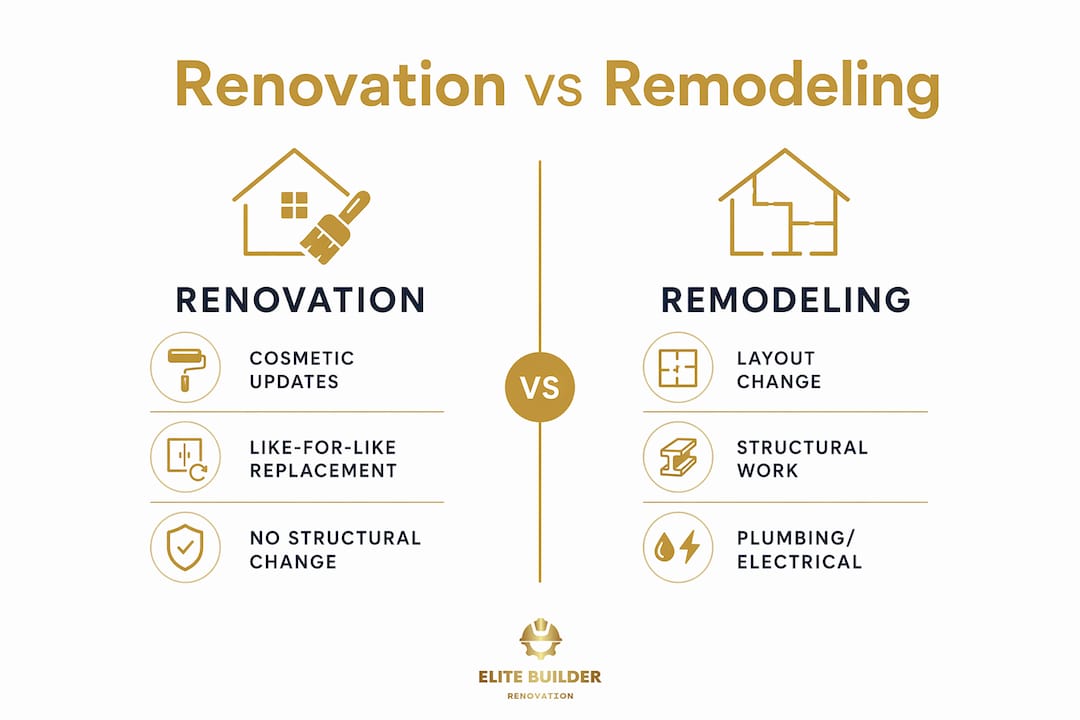
A quick rule of thumb: if the walls stay where they are and no plumbing or electrical circuits move, you are likely renovating. If anything structural or mechanical shifts, you are remodeling.
How do you set clear goals and build a workable budget?
The most common planning mistake homeowners make is anchoring to generic internet prices rather than getting local quotes tied to a defined scope. National averages rarely reflect Tampa Bay labor rates, material costs, or the specific conditions of your home.
Start with your scope list, then build the budget around it. A workable budget has three components:
- Hard costs: Labor and materials. Labor typically accounts for roughly 65% of total project cost, with materials making up the remaining 35%.
- Soft costs: Permits, design fees, engineering reports, and inspections. These are real costs that many homeowners forget to include.
- Contingency: Reserve 10% for well-defined projects on newer homes, and 15–20% for older homes or scopes with unknowns (hidden water damage, outdated wiring, original plumbing).
Use ranges, not single numbers. A bathroom refresh in Clearwater might run $8,000–$14,000 depending on fixture selections, tile choices, and whether plumbing rough-ins need to move. Getting two or three written estimates from licensed contractors gives you a realistic range for your specific scope.
Some targeted projects also offer strong returns. Bathroom renovations can yield a strong return on investment for some projects, making them a sound priority for homeowners who plan to sell.

Pro Tip: Tie your payment schedule to passed construction milestones, not calendar dates. Pay after demo is complete, after rough inspections pass, after drywall is hung, and after punch list is closed. Never pay the full balance before final completion is documented.
How do you find and hire the right contractor or designer?
Who you hire depends on what your project actually requires. For cosmetic updates, a licensed general contractor (GC) can handle the full scope. For layout changes, you may need a designer or architect first. For any work touching electrical panels, plumbing lines, gas, or HVAC, you need licensed trades — not a handyman.
What to verify before signing anything
- Proof of state contractor’s license (Florida requires this for most renovation and remodeling work)
- General liability insurance and worker’s compensation coverage
- References from recent local projects in Tampa, St. Petersburg, or surrounding areas
- A portfolio showing completed work similar to your scope
- A lien-waiver policy (you should receive lien waivers from subcontractors at each payment milestone)
- A sample written estimate that includes exclusions, not just inclusions
Questions worth asking during the estimate review
Ask who handles subcontracting and whether those subs are licensed. Ask how change orders are priced and approved. Ask what the communication schedule looks like during construction. A contractor who cannot answer these questions clearly is a contractor who will create problems later.

Red flags to walk away from: verbal-only scope with no written estimate, requests for full payment upfront, no proof of insurance, and bids that are significantly lower than others with vague exclusions. A low bid with missing line items is not a deal — it is a scope gap you will pay for later.
Request a milestone-linked payment schedule, a certificate of insurance naming you as an additional insured, and confirmation that the contractor will pull all required permits. Unpermitted work creates serious legal and resale risks that follow the property, not just the contractor.
What requires a permit, and how do you check?
Permit requirements are hyper-local. What triggers a permit in Hillsborough County may differ from Pinellas County rules, and both differ from city-level requirements in Tampa or St. Petersburg. The only reliable source is your local Authority Having Jurisdiction (AHJ) — the building department for your municipality or county.
Common permit triggers include:
- Structural changes (removing or adding walls, altering load-bearing elements)
- Moving or adding plumbing lines or gas connections
- New electrical circuits or panel upgrades
- Changes to the building envelope (windows, doors, roofline)
- Egress changes (adding or modifying exterior doors or windows in sleeping areas)
- Converting spaces to new uses, such as finishing a garage or adding a bedroom
Inspection sequence matters. Before closing walls, a second inspection from an electrical or plumbing inspector is required to confirm rough-in work meets building codes. Closing walls before that inspection passes means opening them again — at your expense.
For Florida-specific permit requirements, Elite Builder Renovation’s Florida building permit guide covers state and regional touchpoints. The permit application process guide walks through the steps of applying locally.
Keep every permit approval document in a project file. You will need them for final inspections, for your homeowner’s insurance, and when you sell the property.
What does a typical renovation timeline look like?
Most interior projects follow a standard sequence of phases, including design and permits, demolition, structural work, rough-in trades, inspections, insulation and drywall, finishes, and final punch list and payment. Duration varies widely depending on scope from a few weeks for single-room refreshes to several months for larger projects.
Order long-lead items — cabinetry, specialty fixtures, windows — when you submit permits, not when construction starts. Lead times for custom cabinets in the Tampa Bay market can be several weeks. Waiting until demo is complete to order them stalls the entire project.
When should you hire specialists versus doing it yourself?
The build sequence exists for a reason: doing tasks out of order creates expensive rework. Painting before drywall is finished wastes paint. Installing flooring before plumbing rough-ins are confirmed risks tearing it up again.
What homeowners can safely self-perform
- Interior painting (after drywall is complete and primed)
- Non-structural demolition (removing tile, trim, or fixtures that are not load-bearing)
- Some flooring installation (floating floors, peel-and-stick tile)
- Landscaping and exterior cleanup
What requires licensed professionals
Licensed trades must handle electrical, plumbing, gas, HVAC, and structural changes. Attempting these without licensed professionals risks failed inspections and safety hazards. In Florida, unlicensed electrical or plumbing work can void your homeowner’s insurance and create liability if something goes wrong.
Waterproofing in wet areas — shower pans, tub surrounds, bathroom floors — also requires professional installation. In Tampa Bay’s humid climate, a failed waterproofing membrane leads directly to mold and structural damage. Elite Builder Renovation handles water damage restoration when moisture problems surface during demo, which happens more often than homeowners expect in older Pinellas and Hillsborough County homes.
Pro Tip: Before drywall goes up, photograph every wall cavity showing the rough-in plumbing, electrical, and HVAC runs. Store these photos with your permit documents. They are invaluable for future repairs, additions, and resale disclosures.
How do you choose materials and finishes that will last?
Material selection is where many homeowners lose money — either by choosing trendy finishes that date quickly or by under-specifying for the actual use conditions of the space.
Room-by-room guidance
- Bathrooms and kitchens: Moisture-resistant materials are non-negotiable. Porcelain tile outperforms ceramic in wet areas. For cabinets, plywood construction holds up better than particleboard in Florida’s humidity. Specify moisture-resistant drywall (greenboard or cement board) behind all wet areas.
- High-traffic flooring: Luxury vinyl plank (LVP) has become the dominant choice in Tampa Bay renovations for its durability, water resistance, and cost-effectiveness. Hardwood remains an option in dry living areas but requires acclimation time in Florida’s climate.
- Coastal and UV considerations: Homes in Safety Harbor, Clearwater, and coastal Pinellas County face higher UV exposure and salt air. Exterior-grade finishes on windows and doors, and UV-resistant interior window treatments, extend the life of interior finishes significantly.
Design rules that save money
Pick finishes before rough-ins are set. Changing cabinet layout after plumbing rough-ins are complete means moving pipes — a cost that can easily exceed the savings from any fixture upgrade. Standardize plumbing rough-in heights to match your selected fixtures before the plumber leaves the job site.
For high-use areas, prioritize function over trends. A matte black faucet looks sharp in a showroom but shows water spots in daily use. Brushed nickel and brushed gold finishes are more forgiving in bathrooms that see heavy traffic.
Sustainability and eco-friendly choices
Low-VOC paints and adhesives improve indoor air quality and are now standard on most professional projects. LED lighting throughout reduces energy consumption with no performance trade-off. For flooring, FSC-certified wood and recycled-content LVP are widely available through Tampa Bay suppliers and add a verifiable sustainability credential to the project.
What does a $10,000 bathroom remodel actually include?
A $10,000 budget for a bathroom remodel in Tampa covers a meaningful refresh of a standard 5×8 or 6×8 bathroom — but the scope has to be defined carefully to stay within that number.
Sample $10,000 bathroom scope (what’s typically included)
- Demolition of existing tile, fixtures, and vanity
- New porcelain floor and wall tile (mid-range selection)
- New vanity, toilet, and faucet (stock or semi-custom)
- New light fixture and exhaust fan
- Fresh paint
- Labor and basic permit costs
What this scope typically excludes: moving plumbing rough-ins, replacing the tub or shower pan, structural repairs, custom tile work, or premium fixture upgrades. Any of those additions push the budget higher.
Sample cost breakdown
| Line item | Estimated range |
|---|---|
| Demolition and disposal | $500–$1,000 |
| Tile (floor and walls, mid-range) | $1,500–$2,500 |
| Vanity, toilet, and fixtures | $1,200–$2,000 |
| Labor (tile, plumbing, electrical) | $6,500–$6,500 |
| Permit and soft costs | $300–$600 |
| Contingency (10–15%) | $800–$1,200 |
(Labor updated to match the canonical budget composition: 65% of a $10,000 remodel = $6,500.)
Product selection and local labor rates are the two biggest variables. A homeowner in Largo who selects stock fixtures and standard tile will land at the lower end. A homeowner in South Tampa selecting designer tile and a freestanding tub will exceed this range significantly.
Financing options are available through Elite Builder Renovation for qualified homeowners, making larger scopes accessible without depleting savings. Regardless of financing, always reserve a 10–20% contingency before construction starts.
How Elite Builder Renovation plans and delivers your project
Elite Builder Renovation has completed over 375 projects across Tampa Bay over more than a decade, serving homeowners in Tampa, St. Petersburg, Clearwater, Largo, Safety Harbor, and throughout Pinellas and Hillsborough counties. Every project follows the same contractor-grade process.
The Elite Builder Renovation process
- Free consultation — review your goals, walk the space, and identify any underlying issues
- Scope and design — define exactly what is included, what materials are specified, and what is excluded
- Written estimate with milestones — a detailed document linking each payment to a passed construction milestone, not a calendar date
- Permit handling — Elite Builder Renovation pulls all required permits and manages the inspection schedule
- Construction — licensed and insured trades execute in the correct sequence, with clear communication throughout
- Punch list and closeout — final walkthrough, permit closure, lien waivers, and final payment tied to documented completion
The firm is licensed and insured, carries a 100% satisfaction guarantee, and offers financing options for qualified clients. For homeowners considering a full home remodel in Tampa or a targeted kitchen or bathroom project, the process is the same: scope first, written estimate second, construction third.
View the project portfolio and client reviews to see completed work across Tampa Bay. For kitchen-specific projects, the kitchen remodel service page covers scope options, materials, and timelines in detail.
Key Takeaways
A successful interior renovation starts with a frozen scope, a milestone-linked budget, and licensed contractors who pull their own permits.
| Point | Details |
|---|---|
| Scope before budget | Define every room and item in scope before pricing anything — generic internet averages mislead more than they help. |
| Contingency is mandatory | Reserve 10% for well-defined projects on newer homes and 15–20% for older homes or scopes with unknowns; older homes in Tampa Bay regularly surface hidden moisture or wiring issues. |
| Permits protect you | Unpermitted work creates legal and resale risk; confirm triggers with your local AHJ before construction starts. |
| Sequence prevents rework | Rough-in inspections must pass before walls close; out-of-order work means opening walls again at your cost. |
| Elite Builder Renovation | Offers free consultations, milestone-linked written estimates, and financing options for homeowners across Tampa, St. Petersburg, and Clearwater. |
Your next step with Elite Builder Renovation
Homeowners across Tampa, St. Petersburg, and Clearwater choose Elite Builder Renovation because the process removes the guesswork from renovation interior planning. From the first free consultation through permit handling, licensed construction, and final closeout, every project is backed by a written milestone schedule, a 100% satisfaction guarantee, and financing options for qualified clients. Whether you are refreshing a single bathroom in Largo or undertaking a full home remodel in Hillsborough County, the team brings over a decade of local experience and 375+ completed projects to your job site. Request your free consultation today and get a written estimate tied to real milestones — not a ballpark number from a phone call.
Useful sources and links
- Renovation vs. Remodeling | Angi — definitions, cost ranges, and ROI comparison
- How to Renovate a House | The Spruce — permit triggers and inspection sequence
- Home Remodel Planning Guide | Remodel Calculators — phase sequencing, budget structure, and contingency guidance
- How to Plan a Home Renovation | Build Design Hub — scope-first budgeting and written estimate best practices
- Renovating a House Checklist | Redfin — licensed trades checklist
- Florida Building Permit Requirements | Elite Builder Renovation — state and regional permit guidance for Tampa Bay projects
- Building Code Compliance for Renovations | Elite Builder Renovation — when inspections and licensed trades are required
- Home Renovation Phases Explained | Elite Builder Renovation — detailed phase descriptions and milestone examples
- Local building departments: Hillsborough County Building Services and Pinellas County Building and Development Review Services are the AHJs for most Tampa Bay projects. Always confirm permit requirements directly with your local department before starting work.
FAQ
What is renovation in interior design?
Interior renovation refers to updating a space’s finishes, fixtures, and minor elements without changing its structural layout. It differs from remodeling, which involves structural or layout changes and typically requires permits and licensed trades.
What is the 30% rule for renovations?
The 30% rule is a general guideline suggesting you should not spend more than 30% of your home’s current market value on a renovation. It helps homeowners avoid over-improving relative to neighborhood values, though local market conditions in Tampa Bay can shift this threshold.
What does a $10,000 bathroom remodel look like?
A $10,000 bathroom remodel typically covers demolition, new mid-range tile, a replacement vanity and toilet, updated fixtures, a new exhaust fan, and labor and permit costs for a standard 5×8 or 6×8 bathroom. Moving plumbing rough-ins or adding custom tile work will push the budget higher.
What is the 70/30 rule in interior design?
The 70/30 rule is a design proportion guideline: 70% of a room’s palette should be a dominant color or material, and 30% should be an accent. It helps homeowners create visual balance without overcommitting to a single finish across the entire space.
How long does a typical interior renovation take?
Cosmetic renovations can take as little as a few days to a few weeks. A bathroom renovation typically runs 2–6 weeks, and a kitchen renovation runs 4–8 weeks, depending on scope and whether permits are required.