


Hiring a renovation contractor is the most reliable way to protect your home, your budget, and your time during a remodeling project. A general contractor, the recognized industry term for this professional, manages every stage of a renovation: pulling permits, coordinating licensed tradespeople, and delivering code-compliant results. Approximately 25% of DIY renovation attempts require professional intervention to fix mistakes, adding 15–30% in extra costs beyond the original budget. That single statistic captures the core reason why hire renovation contractor is a question worth answering carefully before you pick up a single tool.
Why hire a renovation contractor for your remodel?
A general contractor serves as the single point of responsibility for your entire project. That role covers far more than swinging a hammer. It includes scheduling inspections, managing subcontractor agreements, sourcing materials, and keeping the project on budget and on schedule. When you hire a licensed professional, you transfer the coordination burden from yourself to someone who does this work every day.

The benefits of hiring renovation experts break down into five clear categories: project management, permit compliance, quality workmanship, risk mitigation, and financial protection. Each one addresses a specific failure point that homeowners encounter when they attempt large remodels without professional support. Understanding each category helps you make a confident, informed decision before your project begins.
How do contractors manage project complexity and coordination?
Professional contractors serve as a single point of responsibility, managing the complex scheduling of multiple trades to prevent costly delays and communication failures. That coordination role is harder than it looks. A kitchen remodel alone typically involves a plumber, an electrician, a tile setter, a cabinet installer, and a painter. Each trade must arrive in the correct sequence, or the project stalls.
A licensed contractor handles all of that sequencing for you. They know that rough plumbing must be inspected before walls close, and that electrical rough-in must pass inspection before insulation goes in. Skipping or reversing that order forces demolition and rework, which adds both time and cost. The role of project manager in renovation is one of the most underappreciated advantages of hiring a professional.
DIY homeowners frequently underestimate the scheduling challenge. A plumber who arrives before framing is complete either waits on your dime or reschedules, pushing every downstream trade back by days or weeks. Contractors maintain established relationships with subcontractors, which means faster callbacks, reliable scheduling, and accountability when work does not meet standard.
Key coordination advantages a contractor provides:
- Manages subcontractor contracts, insurance verification, and payment schedules
- Sequences trades correctly to avoid costly rework and inspection failures
- Handles material deliveries and on-site storage to prevent damage and theft
- Maintains a daily log of progress and flags issues before they escalate
- Communicates directly with municipal inspectors to keep approvals on track
Pro Tip: Before your project starts, ask your contractor for a written schedule showing each trade’s start and end dates. That document becomes your accountability tool throughout the renovation.
What are the permit and code compliance risks of skipping a contractor?
Failure to obtain necessary permits can lead to insurance claim denials for damage caused by unpermitted work, exposing homeowners to major financial loss. That consequence alone justifies the cost of professional contractor services for most homeowners in Tampa, Clearwater, St. Petersburg, and across Pinellas County and Hillsborough County.
Florida building codes are specific and frequently updated. A bathroom remodel that moves a drain line, a kitchen renovation that adds a circuit, or a structural wall removal each require permits and inspections under Florida Building Code standards. Unpermitted alterations decrease home values and force costly retroactive corrections during resale, often costing 25% of the original project expenditure. That is a significant financial penalty for work that seemed like a shortcut at the time.
Understanding Florida building permit requirements is not optional for homeowners planning structural, electrical, plumbing, or mechanical work. A licensed contractor knows exactly which permits apply to your project and handles the application, inspection scheduling, and final sign-off on your behalf.
Common permits required for Tampa Bay area renovations include:
- Electrical permits for panel upgrades, new circuits, or service changes
- Plumbing permits for drain relocations, water heater replacements, or new fixture rough-ins
- Mechanical permits for HVAC system changes or duct modifications
- Structural permits for load-bearing wall removal or additions
- Building permits for room additions, window replacements, or roofing work
Knowing what happens if you do home improvements without a permit is critical before you start any significant project. The short answer: your insurer can deny claims, your municipality can issue a stop-work order, and your buyer’s lender can kill a future sale.
How does professional workmanship protect your home and your investment?
Contractors act as risk managers by identifying hidden issues like faulty wiring or plumbing before they escalate, preventing budget overruns. That early detection is one of the most valuable things a licensed professional brings to any renovation. A homeowner opening a wall for the first time may not recognize aluminum wiring, active mold, or undersized drain lines. A contractor does, and they know exactly how to address each issue within code.
Skilled tradespeople also deliver durable, code-compliant work that holds up over time. Professional grade materials, proper fastening schedules, and correct waterproofing methods all contribute to a finished product that lasts. Avoiding common bathroom remodel mistakes is far easier when a licensed professional manages the work from the start.
Labor costs account for 50–60% of total renovation expenses, and 44% of DIYers redo work due to errors, causing average professional repair bills above $2,200. That repair bill does not include the cost of demolishing the failed DIY work before the professional can begin. Rework in renovation often involves full demolition, which means you pay twice for the same square footage.
Quality and safety advantages of hiring a licensed contractor:
- Identifies hidden structural, electrical, or plumbing defects before they become expensive emergencies
- Applies manufacturer-specified installation methods that preserve product warranties
- Uses licensed subcontractors who carry their own liability insurance and workers’ compensation
- Delivers work that passes municipal inspections, protecting your homeowner’s insurance coverage
- Provides a written warranty on labor, giving you recourse if problems appear after completion
Pro Tip: Always ask for a written workmanship warranty before signing a contract. Reputable contractors in Tampa Bay typically offer a one-year minimum labor warranty on completed work.
Does hiring a contractor actually save money compared to DIY?
Professional remodelers complete tasks faster and more efficiently than unskilled homeowners, often delivering better return on investment when factoring in opportunity costs. Speed matters because a kitchen out of service for six weeks costs more than a kitchen out of service for three weeks, in both convenience and temporary living expenses.
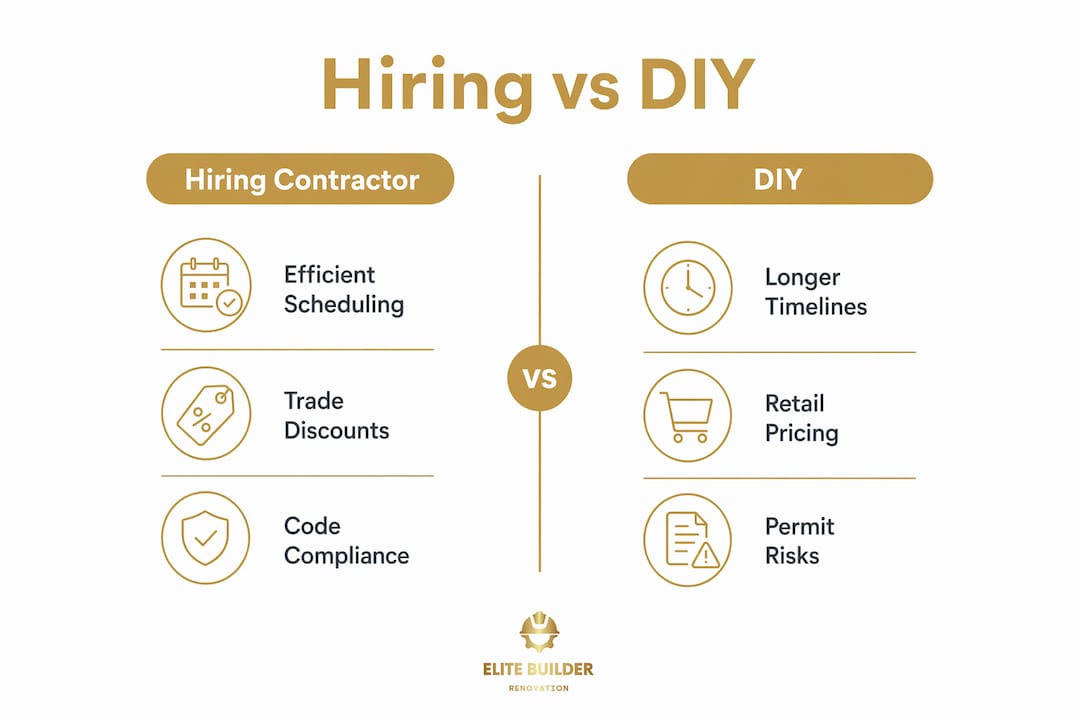
DIY rework costs can run 1.5–2x the price of hiring a professional to do the job correctly from the start. That multiplier reflects the true financial risk of DIY renovation. Contractors also purchase materials at trade pricing, which is consistently lower than retail. That discount on tile, lumber, fixtures, and cabinetry partially offsets the labor cost of hiring a professional.
| Cost Factor | DIY Approach | Hiring a Contractor |
|---|---|---|
| Material pricing | Retail rates | Trade/wholesale pricing |
| Labor cost | “Free” but high error rate | Paid, but efficient and warrantied |
| Permit management | Homeowner’s responsibility | Contractor handles all filings |
| Rework risk | High (44% of DIYers redo work) | Low (professional accountability) |
| Project timeline | Unpredictable, often extended | Scheduled with defined milestones |
| Insurance protection | At risk with unpermitted work | Maintained through code compliance |
The financial case for hiring a professional is strongest on projects involving electrical, plumbing, structural work, or any scope that requires permits. On those projects, the cost of a single mistake routinely exceeds the contractor’s fee.
When does a hybrid renovation approach make sense?
A hybrid renovation approach, where you handle non-technical tasks and hire licensed professionals for permit-required work, can save 20–35% while maintaining code compliance and quality. This model works well for budget-conscious homeowners in areas like Largo, Safety Harbor, and Brandon who want to contribute labor without taking on technical risk.
The key is knowing which tasks are genuinely low-risk and which ones require a license. Painting, demolition of non-structural elements, cleanup, and landscaping are tasks most homeowners can handle safely. Electrical, plumbing, HVAC, and structural work require licensed tradespeople under Florida law, regardless of your skill level.
Tasks homeowners can safely self-perform:
- Interior painting and surface preparation
- Demolition of non-load-bearing walls (after contractor confirms structural safety)
- Cabinet hardware installation after cabinets are set by a professional
- Finish cleaning and debris removal
- Landscaping and exterior cleanup after construction
Tasks that require a licensed professional:
- Any electrical work beyond simple fixture swaps
- Plumbing rough-in, drain relocation, or water heater installation
- HVAC system changes or new duct runs
- Load-bearing wall removal or structural modifications
- Roofing, waterproofing, and moisture barrier installation
Coordinating a hybrid project requires clear communication with your contractor upfront. Define exactly which scopes you will handle and which ones they own. Ambiguity in that boundary creates scheduling conflicts and can void subcontractor warranties if homeowner work precedes or follows professional work incorrectly.
Key Takeaways
Hiring a licensed renovation contractor protects your home’s value, your insurance coverage, and your budget by delivering code-compliant work, managing permits, and preventing the costly rework that affects nearly half of all DIY renovation attempts.
| Point | Details |
|---|---|
| Contractors prevent costly rework | 44% of DIYers redo work due to errors, with average repair bills exceeding $2,200. |
| Permits protect your insurance | Unpermitted work can void insurance claims and reduce home value by up to 25% of project cost. |
| Professional coordination saves time | Contractors sequence trades correctly, preventing delays that extend timelines and increase costs. |
| Hidden issues get caught early | Licensed contractors identify faulty wiring, plumbing faults, and moisture problems before walls close. |
| Hybrid projects offer a middle path | Homeowners can self-perform painting and demo while leaving permit-required work to licensed professionals. |
Elite Builder Renovation: Tampa Bay’s trusted remodeling partner
Elite Builder Renovation has completed over 375 projects across Tampa, St. Petersburg, Clearwater, and the surrounding Tampa Bay area, with a 100% satisfaction guarantee on every job. Their team manages permits, coordinates licensed subcontractors, and handles every stage of your project from initial consultation through final inspection. Whether you are planning a kitchen remodel in Tampa, a bathroom renovation, or a full home remodel, Elite Builder Renovation brings over a decade of local code knowledge and trade relationships to your project. Financing options are available to make professional remodeling accessible regardless of your budget. Read verified client remodeling reviews to see the results firsthand, or contact the team to schedule a no-obligation consultation for your Tampa Bay home.
FAQ
Why hire a renovation contractor instead of doing it yourself?
A licensed contractor manages permits, coordinates trades, and delivers code-compliant work that protects your home’s value and insurance coverage. DIY attempts require professional correction in approximately 25% of cases, adding 15–30% in extra costs.
What questions should I ask renovation contractors before hiring?
Ask about their license and insurance, their experience with your project type, how they handle permits, and whether they provide a written workmanship warranty. Request a detailed written schedule and a line-item cost breakdown before signing any contract.
How do I vet a renovation contractor in Tampa Bay?
Verify their Florida contractor’s license through the Department of Business and Professional Regulation, confirm they carry general liability and workers’ compensation insurance, and check references from recent local projects. Reading verified reviews from past clients is one of the most reliable vetting steps available.
Does unpermitted renovation work affect my home’s resale value?
Unpermitted alterations force costly retroactive corrections during resale and can reduce the effective value of the project by approximately 25% of the original expenditure. Buyers’ lenders frequently require unpermitted work to be legalized or removed before closing.
Can I save money by doing part of the renovation myself?
A hybrid approach, where homeowners handle painting, demo, and cleanup while licensed professionals manage technical and permit-required work, can reduce total project costs by 20–35% without compromising code compliance or quality.