

What is a phased home renovation and how does it work?
A phased home renovation is a planned, staged remodeling process where a homeowner breaks a large project into sequential sections completed over time rather than all at once. Instead of gutting the entire house in a single construction push, you tackle one area or system at a time, allowing each completed phase to support the next. This approach is especially practical for Tampa Bay homeowners who need to stay in their home during construction, manage a limited budget, or simply want to avoid months of total household disruption.
The typical sequence follows a logical, inside-out order:
- Structural and safety work first: foundation repairs, roof replacement, mold remediation
- Major mechanical systems second: HVAC, plumbing, and electrical upgrades
- Functional rooms third: kitchen remodel, bathroom remodel, basement finishing
- Cosmetic finishes last: flooring, paint, lighting, trim, and landscaping
Phased renovations offer financial flexibility by letting you spread remodeling costs over time using savings, tax returns, or smaller loans rather than one large debt. They also reduce lifestyle disruption by isolating active construction to one zone while the rest of the home remains livable.

Benefits and drawbacks of phased renovations
Benefits
Choosing a phased approach gives homeowners real advantages, particularly when budget or living situation makes a full renovation impractical.
- Financial breathing room: You fund each phase separately, avoiding a single large loan and the interest burden that comes with it.
- Stay in your home: Professionals use containment methods like plastic barriers and HEPA filtration systems to isolate work zones, keeping dust and noise manageable.
- Emotional pacing: Breaking decisions into smaller chunks reduces decision fatigue and burnout, helping you make higher-quality choices throughout the project. Industry experts treat emotional pacing as equally important as financial pacing.
- Design flexibility: After completing one phase, you may refine your preferences for the next, leading to better outcomes overall.
- Simpler permitting per phase: Smaller scopes often move through local permitting offices in Pinellas County and Hillsborough County faster than full-home submissions.
Drawbacks
Phasing is not without real trade-offs, and understanding them upfront prevents costly surprises.
- Higher total cost: Phasing generally increases total project cost by approximately 5–20% compared to a single continuous build, due to repeated trade mobilizations, temporary site protections, and fragmented scheduling.
- Extended timeline: A phased remodel tends to extend total project duration by 30–60% versus a continuous build, which matters if you have a firm move-in or sale deadline.
- Design inconsistency risk: Product lines can be discontinued or changed between phases, leading to mismatched finishes if you haven’t locked in your selections early. This is one of the most common material and design risks homeowners overlook.
- Increased project management complexity: Coordinating multiple permits, inspections, and trade crews across separate mobilizations demands more oversight than a single continuous build.
How to plan and execute a phased home renovation
Effective phased remodeling depends on a clear master plan established before the first hammer swings. Here is the sequence that experienced contractors follow:
-
Freeze the master design. Lock in your floor plan, material selections, and finish choices before demolition begins. Every decision made during construction instead of during design costs significantly more to change. Freezing the overall design before phase one is the single most important step in preventing layout conflicts and material mismatches later.
-
Follow the bones-out sequence. Address structural and safety issues first, then mechanical systems, then functional rooms, then cosmetics. Deviating from this order leads to tearing out finished work to reach systems that should have been handled earlier.
-
Budget each phase with a contingency. Allocate a 10–20% contingency reserve per phase, leaning toward 15–20% for older Tampa Bay homes with unknown structural conditions. Factor in material inflation between phases as well.
-
Pull permits sequentially. Each phase involving structural changes, electrical, plumbing, or HVAC typically requires its own permit. Milestone-based permit tracking keeps the project code-compliant and protects resale value.
-
Schedule breaks between phases deliberately. Build in recovery time between phases to rebuild your budget and reset your decision-making energy. Firm completion criteria for each stage prevent unfinished spaces from lingering indefinitely.
-
Plan for living in the home. Keep at least one functional kitchen and one functional bathroom accessible at all times. Coordinate with your contractor to sequence work room by room rather than floor by floor when possible.
Pro Tip: Run electrical, plumbing, and HVAC rough-ins during the earliest phases, even if you plan to defer the finish work. Retrofitting these systems through finished walls later is dramatically more expensive than running them while walls are already open.
Is a phased renovation the right choice for you?
Not every project benefits from phasing. The approach fits best under specific conditions, and being honest about your situation saves time and money.
Phasing makes sense when:
- You need to stay in the home during construction and cannot afford temporary housing.
- Your budget requires spreading costs over months or years rather than committing to a large upfront investment.
- You have the patience to tolerate intermittent construction noise and disruption over an extended period.
- Your project is large in scope, such as a whole-home renovation in Clearwater or a multi-room update in St. Petersburg, where tackling everything at once would be financially or logistically overwhelming.
- Your long-term plans for the home are still evolving, and you want flexibility to adjust priorities between phases.
A continuous, full renovation may be preferable when:
- You have a firm deadline, such as a planned home sale or a family move-in date.
- Your budget allows the full scope to be funded at once, avoiding the 5–20% cost premium that phasing carries.
- Your project involves replacing all mechanical systems throughout the home, since mobilizing trades once for the whole house is significantly more efficient than three separate mobilizations.
- You prefer design cohesion and a single, predictable finish line rather than years of intermittent work.
Small, targeted remodels, like a single bathroom remodel in Tampa Bay, rarely benefit from phasing. The overhead of multiple mobilizations outweighs the flexibility gain when the scope is contained.
Expert insights on avoiding costly mistakes in phased renovations
The biggest misconception about phasing is that it simplifies a renovation. In reality, it greatly increases project complexity, requiring stronger project management and stricter adherence to a master plan than a single continuous build.
Common mistakes Elite Builder Renovation sees in Tampa Bay phased projects:
- Working out of sequence. Starting with cosmetic upgrades before addressing structural or mechanical issues is the most expensive error in phased renovations. New flooring installed over aging plumbing, or fresh drywall covering outdated wiring, creates rework costs that dwarf the original savings.
- Skipping the design freeze. Homeowners who defer material selections often discover that their chosen tile, cabinet line, or hardware has been discontinued by the time phase two begins. Locking design early is the only reliable protection against this.
- Underestimating mobilization costs. Each time a trade crew returns to a site, there are setup, protection, and coordination costs. The flexibility premium is real, and it compounds across multiple phases.
- No firm completion criteria. Without defined finish lines for each phase, projects stall in a perpetual state of “almost done.” Unfinished spaces affect daily life and can complicate future phases.
Pro Tip: Track progress by milestones, not by calendar days. Key checkpoints like permit approval, rough inspection passed, and stage completion give you a reliable picture of where the project stands and what decisions you need to make next.
At Elite Builder Renovation, with over 375 completed projects across Hillsborough and Pinellas counties, the team consistently finds that homeowners who invest in a thorough upfront plan before phase one experience fewer change orders, lower total costs, and less stress throughout the process. You can review the home renovation phases guide for a detailed breakdown of sequencing by project type.
Phased renovation vs. full renovation: which approach costs less?
The honest answer is that a full renovation is almost always less expensive in total dollars, while a phased renovation is less expensive in any single year. Understanding that distinction helps you choose the right path.
| Factor | Phased renovation | Full renovation |
|---|---|---|
| Total cost | Higher by 5–20% due to repeat mobilizations | Lower overall when funded at once |
| Annual cash outlay | Lower, spread over years | Higher, concentrated upfront |
| Timeline | Extended by 30–60% | Shorter, single finish line |
| Design cohesion | Requires early planning to maintain | Naturally consistent |
| Disruption | Frequent but contained | Intensive but time-limited |
| Living in home | Generally possible | May require temporary housing |
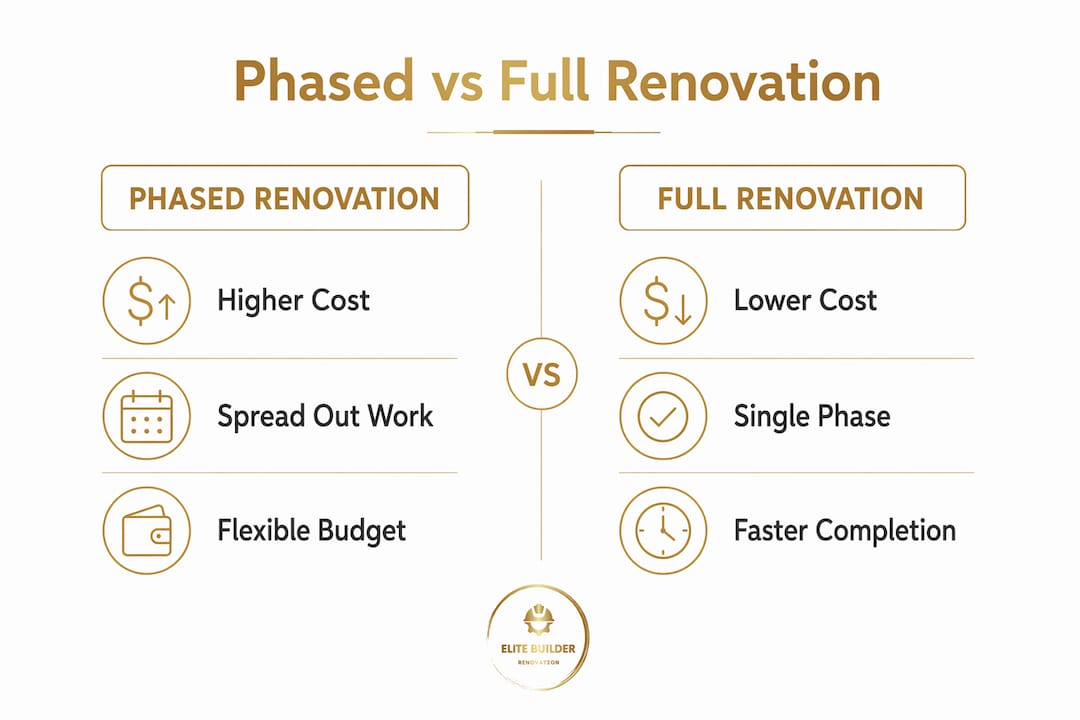
A full renovation consolidates trade mobilizations, bulk material purchasing, and permit processing into a single effort. That efficiency produces a lower total price. The phased approach trades that efficiency for cash flow flexibility and the ability to remain in the home, which for many Tampa Bay homeowners is worth the premium. As one industry analysis notes, the cost of phasing represents the price paid for operational flexibility, not a sign of poor planning.
The right comparison is not “which is cheaper” but “which is feasible given your budget, timeline, and living situation.”
How phased renovations affect home value and resale
Done correctly, a phased renovation builds home value incrementally with each completed stage. Done poorly, it can leave a home in a partially updated state that actually complicates resale.
The industry-recognized “30% rule” cautions against spending more than 30% of a home’s current market value on renovations, to avoid over-improving relative to the neighborhood. This budget guideline is not a legal requirement, but it shapes how appraisers and buyers evaluate renovated homes. Each phase should add practical, functional value, not just aesthetic upgrades, to protect your return.
Structural and mechanical improvements completed in early phases, such as a new roof, updated electrical panel, or replumbed water lines, directly support appraisal value and pass home inspection without issue. Cosmetic phases add perceived value but carry more risk of personal taste not aligning with buyer preferences. For homeowners in Safety Harbor, Largo, or St. Petersburg who plan to sell within a few years, prioritizing functional upgrades in early phases and deferring highly personalized finishes tends to produce the strongest resale outcome.
One practical risk: a home mid-renovation, with one phase complete and another not yet started, can be harder to price and sell than either a fully updated or fully original home. If resale is a near-term goal, completing at least one self-contained, functional area before listing protects your negotiating position.
Ready to start your phased renovation in Tampa Bay?
Elite Builder Renovation has guided homeowners across Tampa, St. Petersburg, Clearwater, and the surrounding communities through phased home renovations for over a decade. With more than 375 completed projects, a 100% satisfaction guarantee, and financing options that make phased planning accessible, the team brings the structure and expertise your project needs from phase one through final completion. Whether you’re starting with a kitchen remodel or planning a full home transformation in Tampa, Elite Builder Renovation is ready to build your master plan with you.
Key Takeaways
A phased home renovation succeeds when the full design is frozen before phase one begins, structural and mechanical work precedes cosmetics, and each phase is budgeted with a contingency reserve.
| Point | Details |
|---|---|
| Sequence is non-negotiable | Always complete structural, then mechanical, then functional rooms, then cosmetic finishes. |
| Cost premium is real | Phasing adds approximately 5–20% to total project cost compared to a continuous build. |
| Timeline extends significantly | Expect total project duration to run 30–60% longer than a continuous renovation. |
| Freeze design before starting | Lock material selections and floor plans before demolition to prevent mismatches and rework. |
| 30% rule guides budget allocation | Avoid spending more than 30% of your home’s value on renovations to protect resale return. |
FAQ
What is a phased home renovation?
A phased home renovation breaks a large remodeling project into sequential stages completed over time, typically starting with structural and mechanical work and finishing with cosmetic upgrades. Homeowners choose this approach to manage budgets, reduce disruption, and stay in the home during construction.
What is the 30% rule in remodeling?
The 30% rule advises homeowners not to spend more than 30% of their home’s current market value on renovations, to avoid over-improving relative to comparable homes in the neighborhood. It is not a legal requirement but is widely used as a budget guardrail by contractors and appraisers.
How much more does a phased renovation cost than doing it all at once?
Phasing typically adds 5–20% to the total project cost compared to a continuous build, due to repeated trade mobilizations, temporary site protections, and fragmented scheduling. The premium buys financial and operational flexibility for homeowners who cannot fund or tolerate a full renovation at once.
Can you live in your home during a phased renovation?
Yes. Phased renovations are specifically designed to allow homeowners to remain in the home by isolating active work zones with containment barriers and HEPA filtration systems. The key requirement is maintaining at least one functional kitchen and one functional bathroom throughout the process.
What is the most expensive part of a house to renovate?
Kitchen and full bathroom remodels consistently rank as the most expensive individual rooms to renovate due to the concentration of plumbing, electrical, cabinetry, and finish work in a small area. Whole-home mechanical system replacements, including HVAC, plumbing, and electrical panels, often exceed individual room costs when addressed together.