
Office remodel cost in Florida runs from about $50 to $100 per square foot for a light refresh, $100 to $200 for a mid-range tenant improvement, and $250 or more for a full high-end overhaul. In a 5,000 square foot space, that full overhaul can exceed $1.25 million. The biggest swing factor is almost always mechanical, electrical, and plumbing work hiding behind the walls. Before you sign anything, schedule a licensed contractor’s pre-design assessment so those surprises show up on paper instead of as a change order mid-project.
TL;DR:
- Mechanical, electrical, and plumbing work can account for up to 45% of total remodeling costs, especially in older buildings with outdated systems.
- Coastal wind zone requirements often add 5% to 15% to the structural and envelope portions of the budget due to reinforcement and impact-rated glazing.
- Permit and soft costs generally make up 0.5% to 2% of the construction budget, but can increase if additional impact or occupancy fees apply.
- Mid-range tenant improvements typically cost between $100 and $200 per square foot, with full overhaul costs exceeding $250 per square foot, depending on scope and building conditions.
- A thorough pre-design assessment can identify hidden issues with MEP and structural capacity, helping to prevent unexpected mid-project cost increases.
Table of Contents
- What Does Office Remodel Cost in Florida Break Down By Square Foot?
- Why Do MEP and Structural Work Drive Up Office Renovation Costs?
- How Much Do Florida Permits and Plan Review Add to the Budget?
- Sample Office Remodel Budgets by Square Footage
- How Long Does an Office Remodel Take in Florida?
- How Do You Choose and Negotiate With a Florida Contractor?
- Elite Builder Renovation’s Track Record on Florida Commercial Remodels
- How Do Remodel Costs Vary Across Florida Cities and Counties?
- What Does Hurricane-Resilience Code Compliance Add to the Budget?
- What Ongoing Costs Come After the Remodel Is Complete?
- Get a Free Office Remodel Estimate From Elite Builder Renovation
- Primary Sources and Local References
- Sources
- FAQ
What Does Office Remodel Cost in Florida Break Down By Square Foot?
Matching your project to the right cost band starts with being honest about scope. A “light refresh” and a “full overhaul” produce very different invoices, and confusing the two is the number one reason budgets blow past their original estimate.
Light refresh ($50 to $100 per sq ft): This covers paint, carpet or LVP flooring replacement, ceiling tile swaps, light fixture updates, and minor cosmetic touch-ups to existing walls. MEP systems stay largely untouched. Expect no structural work and minimal permit complexity.
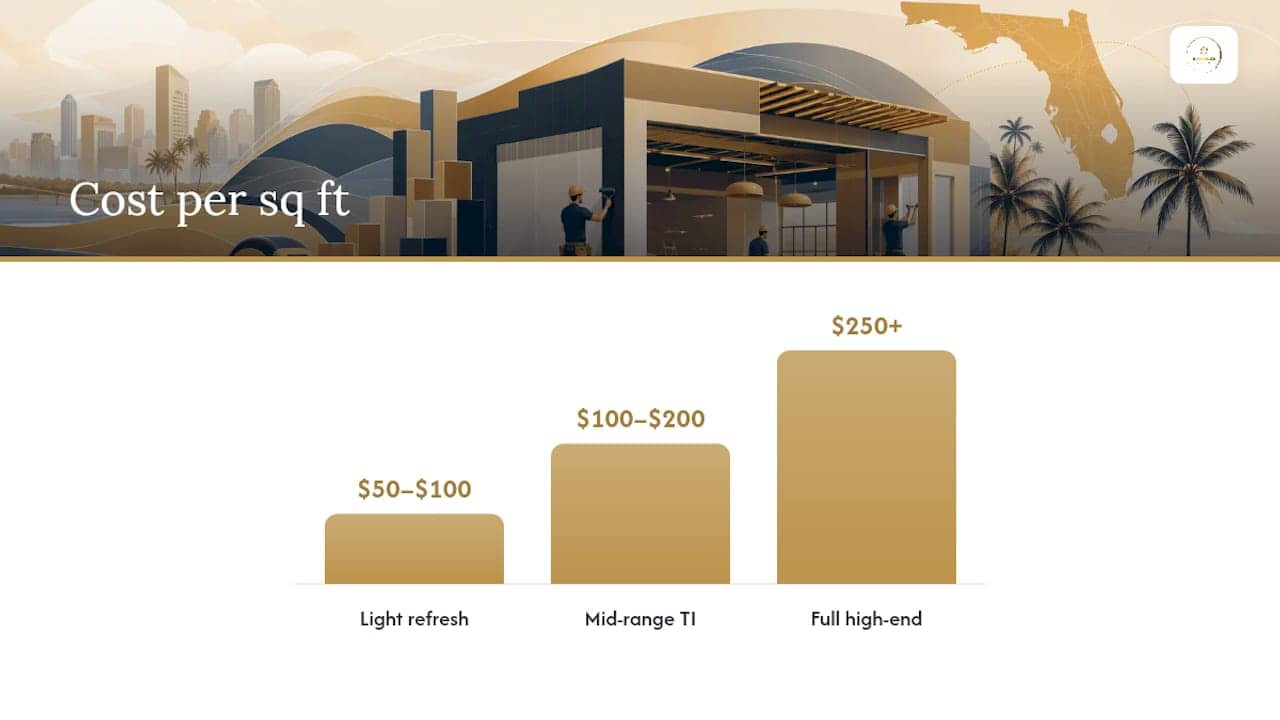
Mid-range tenant improvement ($100 to $200 per sq ft): This is where most Florida office remodels land. It typically includes new partition walls, upgraded flooring throughout, redesigned lighting, and moderate HVAC rebalancing. Office TI benchmarks in Florida commonly fall between $60 and $150 per square foot depending on finish level and how much ductwork and electrical capacity the space needs.
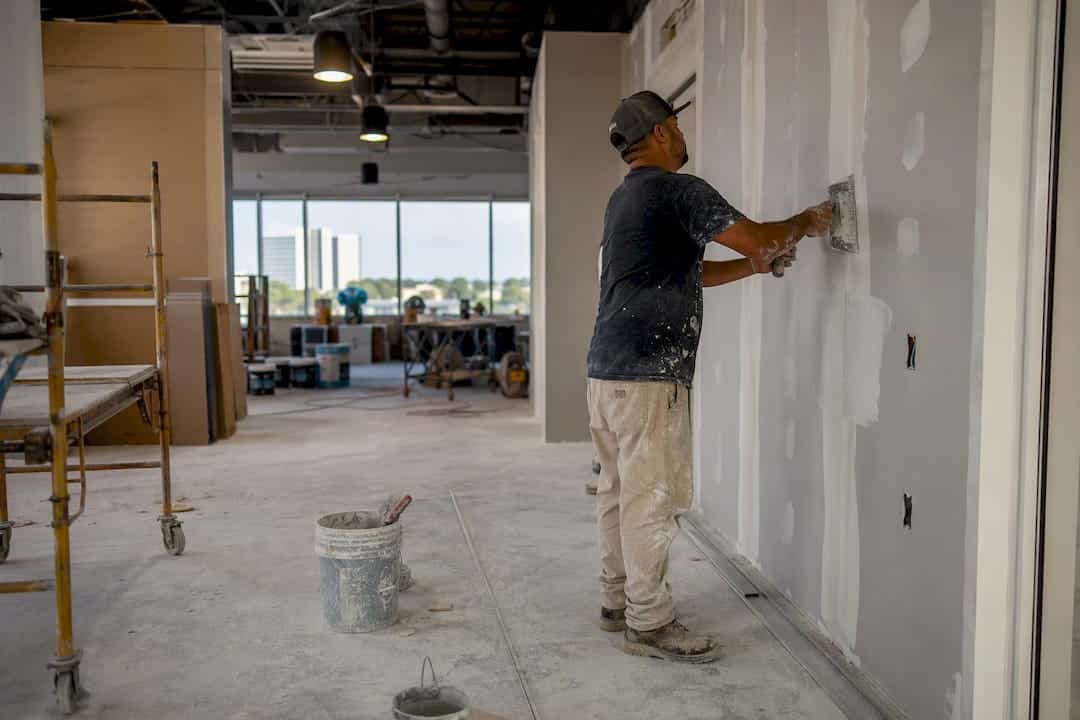
Full high-end overhaul ($250+ per sq ft): This band involves new MEP systems from the panel out, structural modifications, glass wall systems, premium millwork, and often a full ceiling and lighting redesign. Coastal wind requirements and impact-rated glazing push this band higher still.
Here’s how those bands translate into real dollars:
- 1,000 sq ft: light refresh $50,000 to $100,000; mid-range $100,000 to $200,000; full overhaul $250,000+
- 2,500 sq ft: light refresh $125,000 to $250,000; mid-range $250,000 to $500,000; full overhaul $625,000+
- 5,000 sq ft: light refresh $250,000 to $500,000; mid-range $500,000 to $1,000,000; full overhaul $1.25 million+
These ranges align with RSMeans commercial renovation cost data and Cushman & Wakefield fit-out benchmarking, both standard references contractors use to sanity-check bids before they go out.
Why Do MEP and Structural Work Drive Up Office Renovation Costs?
Cosmetic scope is easy to estimate. What blows up a budget is what’s behind the drywall, and Florida’s aging commercial stock makes this more common than most tenants expect.
MEP is usually the single largest line item. HVAC tonnage upgrades, electrical service increases for added workstations or server rooms, and plumbing rough-ins for new break rooms or restrooms commonly account for 30% to 45% of total build-out cost. A building with an undersized electrical panel or a 20-year-old rooftop unit can turn a “simple” layout change into a mechanical project. Our own HVAC planning guide covers how zoning and capacity decisions ripple through the rest of a remodel budget.

Structural changes cost more than they look like they should. Removing a load-bearing wall, cutting a floor penetration for new plumbing, or adding roof-mounted equipment often requires an engineer’s stamp and additional permitting, adding both hard cost and schedule time.
Coastal wind requirements add a real premium. Properties near the Gulf or in wind-borne debris zones need impact-rated glazing and reinforced storefront systems, which typically cost more than standard glass and framing.
Soft costs add up quietly. Architect and engineering fees, special inspections, and permit expediting fees typically run 10% to 15% of the total project on top of construction costs.
Pro Tip: Ask your contractor to walk the mechanical room and electrical panel during the initial site visit, not after demo starts. Undersized panels and failing rooftop units are the most common source of “surprise” change orders in Florida office remodels.
How Much Do Florida Permits and Plan Review Add to the Budget?
Permit costs in Florida are rarely a flat fee. Most municipalities use tiered schedules based on construction value, and skipping this line item in your budget is a common rookie mistake.
The City of Orlando’s commercial permit fee schedule illustrates the model well: fees are calculated per $1,000 of declared construction value, with separate line items for plan review, reinspections, and overtime inspections when you need to expedite a schedule. Other Pinellas County and Hillsborough County jurisdictions follow similar tiered structures, though exact rates vary by city.
Plan review timelines can vary widely depending on jurisdiction backlog and drawing complexity, sometimes taking several weeks to a few months.
Extra fees to budget for beyond the base permit:
- Reinspection fees when work fails a first inspection
- Overtime or expedited review surcharges for compressed schedules
- Impact fees, which apply in some jurisdictions for expanded occupancy
- Certificate of occupancy fees at project closeout
Altogether, these administrative costs typically run 0.5% to 2% of hard construction costs on a well-managed project, according to permit fee data from the Orlando permitting schedule. If your remodel qualifies as a “substantial improvement” under floodplain rules, or triggers ADA path-of-travel upgrades to restrooms and entries, budget for additional review time and potential added scope. Our commercial permit process guide walks through submittal requirements in more detail.
Sample Office Remodel Budgets by Square Footage
Seeing a real line-item breakdown makes it much easier to compare contractor bids apples to apples. Here are three worked examples across the sizes we see most often in Tampa Bay.
- 1,000 sq ft light refresh, total roughly $75,000: Flooring and paint $25,000; lighting and ceiling $15,000; minor electrical $10,000; permits and soft costs $5,000; contingency $8,000; remaining $12,000 for demo and cleanup.
- 2,500 sq ft mid-range TI, total roughly $375,000: MEP upgrades $130,000; partitions and drywall $60,000; flooring and finishes $75,000; lighting $30,000; permits and soft costs $30,000; contingency $50,000.
- 5,000 sq ft full overhaul, total roughly $1,400,000: MEP and structural $550,000; finishes and millwork $400,000; glazing and envelope work $150,000; permits and soft costs $100,000; contingency $200,000.
To scale these for your own space, apply the per-square-foot bands from the sections above to your exact footage, then adjust upward for coastal wind requirements, older building stock, or aggressive timelines. Our commercial renovation planning guide has additional worksheets for adjusting these baselines to your specific building.
How Long Does an Office Remodel Take in Florida?
A light refresh typically wraps in 4 to 8 weeks. A mid-range TI usually runs 3 to 5 months once permitting is included. A full overhaul with structural or MEP work commonly stretches 6 to 10 months from design through final inspection.
Long-lead items deserve early attention:
- Impact-rated glazing: order 8 to 12 weeks ahead
- Packaged HVAC units: order 6 to 10 weeks ahead
- Custom millwork: order 6 to 8 weeks ahead
For contingency, budget 5% to 10% on straightforward light refreshes, 10% to 20% on mid-range TIs, and 20% or more on full overhauls involving older buildings or unknown structural conditions.
Pro Tip: Ask your contractor to submit for permits in phases when possible, starting with demolition and MEP rough-in, so crews can start early work while finish-level plans finish review.
How Do You Choose and Negotiate With a Florida Contractor?
Hiring right is the single biggest lever you control on total office remodel cost in Florida. A few due-diligence steps up front prevent most of the disputes that inflate budgets later.
Confirm your contractor holds an active Florida general contractor license and current liability and workers’ compensation insurance. Florida Statute §489.103 makes clear that owner-builder exemptions don’t apply to commercial leaseholds, so any licensed permit work must go through a properly licensed contractor.
Before accepting firm pricing, insist on a pre-design assessment covering existing MEP capacity, structural conditions, and any ADA path-of-travel triggers your scope might create. Our pre-remodel evaluation checklist outlines what a thorough inspection should catch before pricing locks in.
When comparing bids, require:
- A detailed scope matrix, not a lump-sum paragraph
- Clearly stated allowances for finishes and fixtures
- Written change-order procedures and markup rates
- Confirmation of who handles permit submittal and fees
Red flags include vague scope language, no reference projects, and reluctance to provide license verification.
Elite Builder Renovation’s Track Record on Florida Commercial Remodels
Elite Builder Renovation has completed more than 375 successful projects across the Tampa Bay area over more than a decade, spanning both residential and commercial scopes.
- Pre-design assessments that catch MEP and structural issues before pricing locks in
- Full permit handling across Hillsborough and Pinellas County jurisdictions
- Transparent scope matrices and allowance schedules on every proposal
On a recent Tampa Bay commercial buildout, a property manager came to us with a space that looked cosmetically simple but had a 25-year-old electrical panel undersized for the planned workstation count. Our pre-design assessment flagged the panel upgrade before pricing was finalized, keeping the project on its original budget instead of triggering a mid-construction change order. That’s the value of catching problems on paper. Our structural inspection guide covers what our team checks before any firm number goes to a client.
How Do Remodel Costs Vary Across Florida Cities and Counties?
Regional wind zone requirements get most of the attention, but city-level and county-level factors shift budgets just as much within the same coastal band.
Tampa and Hillsborough County generally see mid-range TI pricing land toward the middle of the $100 to $200 per square foot band, with permit review timelines that are moderate compared to more built-out coastal markets. St. Petersburg and Pinellas County, being more built out and with a larger share of older commercial stock, tend to carry higher electrical and plumbing rework costs on renovation projects simply because more buildings need service upgrades to meet current code.
Clearwater and Largo often see permit review move a bit faster than larger metro areas, which can shave real weeks off a mid-range project’s soft-cost timeline. Safety Harbor’s smaller commercial base means fewer contractors compete for projects there, which can push labor pricing slightly above what you’d see in denser submarkets.
Orlando’s published fee schedule, cited earlier for its tiered structure, tends to run comparable to Tampa Bay on a percentage basis, though total dollar amounts differ with the higher construction values typical of larger downtown office buildings. South Florida markets, including Miami-Dade and Fort Lauderdale, consistently run at the top of every cost band due to labor demand and stricter wind mitigation requirements. If your portfolio spans multiple Florida markets, price your Tampa Bay project against Tampa Bay benchmarks specifically. A Miami-Dade fee schedule or labor rate does not transfer directly to Hillsborough or Pinellas County.
What Does Hurricane-Resilience Code Compliance Add to the Budget?
Impact glazing gets the headlines, but Florida’s structural requirements for wind resistance reach well beyond windows and doors, and they carry real cost implications for office remodels.
Roof-to-wall connections often need reinforcement when a remodel touches the roof structure or adds rooftop equipment like new HVAC units. Engineers may require hurricane straps or clips be added or upgraded to meet current Florida Building Code wind-load provisions, even on a project that started as a cosmetic renovation.
Storefront and curtain wall systems in coastal wind zones require structural testing and product approval documentation, which adds both material cost and a documentation step to your permit submittal. This is separate from, and in addition to, the glazing itself.
Continuous load path requirements can also come into play on structural modifications, meaning a wall removal or new opening may require additional framing reinforcement to maintain the building’s overall wind resistance, not just the immediate opening. This is one of the areas Florida-specific rules add hidden cost layers that a scope review based purely on finishes will miss entirely.
Budget an additional 5% to 15% on the structural and envelope portions of a remodel in designated wind-borne debris zones, layered on top of whatever glazing premium you’ve already accounted for. This is exactly the kind of item a pre-design assessment should flag before you get a firm number, since retrofitting for these requirements mid-project is far more expensive than designing around them from the start.
What Ongoing Costs Come After the Remodel Is Complete?
The invoice for your office remodel isn’t the last cost you’ll see. Planning for post-construction expenses keeps your total cost of occupancy realistic.
Most reputable Florida contractors provide a workmanship warranty, commonly one to two years on labor, with manufacturer warranties on major equipment like HVAC units running longer, often 5 to 10 years on parts. Confirm in writing what’s covered and for how long before the project closes out.
HVAC systems need annual service contracts to maintain efficiency and warranty validity, typically running a modest annual fee depending on system size and unit count. Skipping this is one of the fastest ways to void manufacturer coverage on new rooftop units.
Commercial finishes in Florida’s humid climate need periodic attention: caulking and sealant maintenance around exterior glazing, HVAC coil cleaning to prevent mold growth in ductwork, and touch-up painting in high-traffic areas. Budget a modest annual maintenance allowance, often estimated as a small percentage of original construction cost, to keep the space performing the way it did at handoff.
If your remodel included new impact glazing or storefront systems, ask your installer about the product approval documentation and warranty terms specific to wind-rated components. These typically carry longer warranty periods than standard glazing given the added cost, and you’ll want that paperwork on file for future insurance or resale purposes.
Get a Free Office Remodel Estimate From Elite Builder Renovation
Elite Builder Renovation is the local alternative to a rotating cast of subcontractors and unclear pricing: one licensed team handles design coordination, permitting, and construction from your first walk-through to final inspection, across both commercial and residential projects throughout Tampa Bay. That end-to-end handling is exactly what prevents the MEP surprises and permit delays covered above from ever reaching your final invoice.
We offer free consultations and financing options so budgeting a remodel doesn’t mean choosing between doing it right and doing it now. Before your estimate appointment, gather your lease or space plan, a rough finish wish list, and your target move-in timeline. That’s enough for our team to scope a pre-design assessment and put together a sample budget you can compare against your own numbers.
If you manage properties or lease space in the Tampa Bay area and want firm numbers instead of rough guesses, start with our Tampa office remodel and renovation services page and request your free consultation today.
Primary Sources and Local References
For further verification, consult the City of Orlando commercial permit fee schedule for permit fee formulas, and the RSMeans-based Florida commercial remodel cost guide for unit-cost benchmarking against Cushman & Wakefield fit-out data. Florida contractors handling Miami-Dade submittals can also reference the Miami-Dade commercial permit checklist from MiamiPermitAI. For county-specific permit requirements, review our own Florida building permit requirements guide.
Sources
- Commercial Remodel Cost in Florida: Honest 2026 Cost Guide
- Commercial Tenant Improvement Cost Per Sq Ft in Florida | Benchmark Building Group
- Permitting Development Fees – Commercial (City of Orlando) — Effective January 2026
- Fort Lauderdale commercial buildout costs
FAQ
How Much Does It Cost to Remodel an Office in Florida?
Office remodel cost in Florida typically ranges from $50 to $100 per square foot for a light refresh, $100 to $200 for a mid-range tenant improvement, and $250 or more for a full high-end overhaul, according to Florida commercial cost benchmarks.
How Much Remodeling Can Be Done With $100,000?
At $100,000, you can comfortably complete a light refresh on a 1,000 square foot office, covering flooring, paint, lighting, and minor cosmetic upgrades, or a smaller portion of a mid-range tenant improvement if MEP work is minimal.
Is $10,000 Enough for a Bathroom Remodel in a Commercial Space?
For a small commercial restroom update involving fixtures, flooring, and paint without moving plumbing lines, $10,000 can be workable, but any relocation of plumbing or ADA-triggered upgrades will likely push costs higher.
How Much Does It Cost to Build a 4,000 Sq Ft Office?
A mid-range tenant improvement for a space larger than 2,500 square feet generally runs between the scaled per-square-foot bands, and a full high-end overhaul can exceed $1.25 million on a 5,000 square foot space, based on the same per-square-foot bands used throughout this guide.
What’s the First Step Before Getting a Firm Office Remodel Quote?
Schedule a licensed contractor’s pre-design assessment covering MEP capacity, structural conditions, and code triggers, since this step catches the issues that most commonly cause budget overruns after construction starts.
Recommended
- Kitchen Renovation Cost in Florida: Full Price Guide – Elite Builder Renovation
- Bathroom Renovation Costs in Florida: Full Guide – Elite Builder Renovation
- Kitchen Remodel Cost in Tampa Bay: 2026 Pricing Guide – Elite Builder Renovation
- Fireplace Building Cost in Florida: Guide for Homeowners – Elite Builder Renovation